
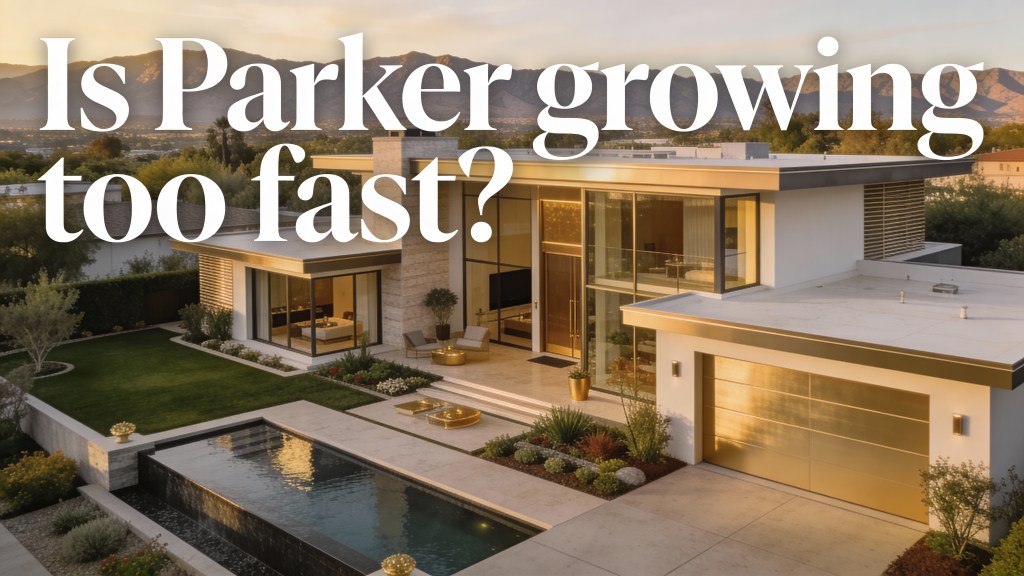
When people ask me if Parker is growing too fast, my honest answer is that Parker is absolutely growing quickly, but “too fast” really depends on what you value most. Population has increased more than 28% over the last decade, and current estimates show annual growth running around 4% per year, which is well above the national average. At the same time, home prices and inventory are starting to show signs of a market that’s maturing rather than just overheating.
What Parker’s Growth Really Looks Like
Parker has transformed from a small town into one of the fastest‑growing suburbs in the Denver metro area, thanks to strong Douglas County schools, newer housing, and a location that offers reasonable commutes into Denver and the Tech Center. The population has climbed from under 50,000 about a decade ago to more than 60,000 today, with projections into the upper 60,000s over the next few years.
On the housing side, the median listing price sits in the low‑ to mid‑$700,000s, with sold prices a bit below that and year‑over‑year price changes in the low single digits. That tells me demand is still healthy, but buyers have a bit more breathing room than during the peak of the last cycle. New construction in communities like Looking Glass and other south and southwest Parker developments continues to add options and variety, which helps relieve some pressure.
The Upsides and Trade‑Offs of Rapid Growth
With rapid growth, you always get trade‑offs. On the upside, Parker’s expansion brings new retail, restaurants, schools, and parks, which can benefit long‑term homeowners and investors. For many of my Denver real estate clients, Parker offers that blend of small‑town main street, newer homes, and strong schools that can be hard to find closer in.
The trade‑offs show up in traffic, longer construction timelines, and the feeling that open space is shrinking faster than some residents would like. As more new communities come online, competition between sellers increases, and buyers can become more selective. In the context of the broader Colorado housing market, Parker is moving from “up‑and‑coming” to “established,” and that shift requires a more strategic approach whether you are buying or selling.
How I Help Clients Navigate Parker
When I help clients consider Parker alongside places like Littleton real estate or Highlands Ranch real estate, I focus on three questions:
- Does the current and projected growth align with your lifestyle expectations over the next 5–10 years?
- Does the price point in your target neighborhoods still make sense compared to similar options in other Denver suburbs?
- Are you comfortable with the pace of change, knowing that more homes, roads, and commercial projects are likely on the way?
From my perspective, Parker is growing fast, but not in a way that automatically makes it a bad choice. For many of my clients, the growth is exactly what creates opportunity and long‑term value.
If you want honest guidance, clear market insight, and a no‑pressure conversation about whether Parker or another Denver‑area community is the right fit, I would be glad to talk through your situation. You can also head to www.MileHighHomeGroup.com to search properties, explore Denver and the surrounding suburbs, learn more about me, and connect when the timing feels right.
 Mile High Home Group - Welcome to Denver
Leave a comment