
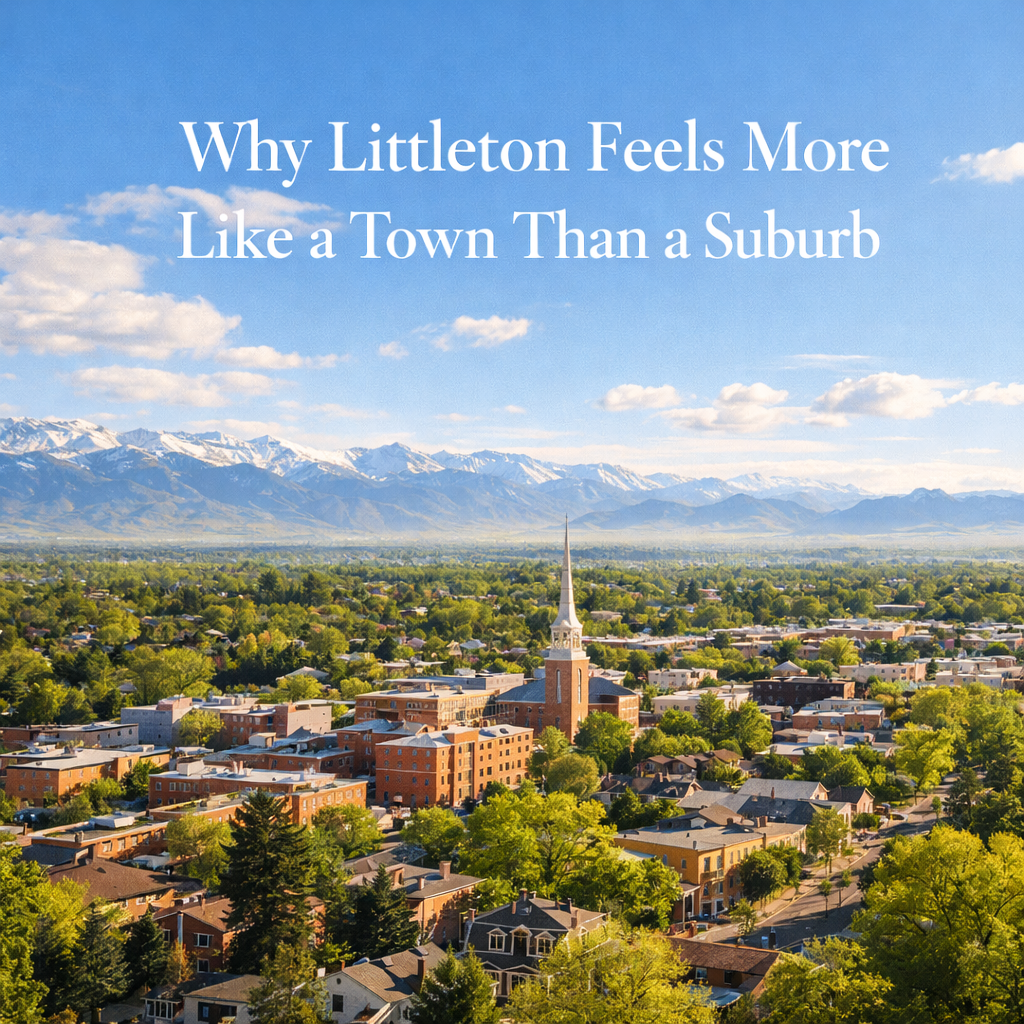
Littleton stands apart in the Denver metro as a pocket of town-like cohesion amid sprawling suburbs, where mature streets, local governance, and terrain create self-contained rhythms absent in growth-heavy Parker or Lone Tree. Homes here benefit from prioritized arterials, stable mill levies, and walkable cores that sustain 4-6% resale premiums and 20-day faster velocity compared to transitional edges. This character matters because it translates to predictable ownership costs, family retention, and equity stability in Jefferson and Arapahoe County pockets where density meets foothills without isolation.
Buyers seeking town-scale predictability over suburban expanse find Littleton aligning daily life with long-term value.
Historic Core Anchors Walkable Density
Downtown Littleton’s pre-1950s grid fosters block-scale commerce — grocers, cafes, and brewpubs within 10-minute walks — mirroring small-town containment versus Highlands Ranch’s car-centric master plans. Properties near Main Street command 5-7% uplifts, as families value school proximity without C-470 navigation.
Mature elms shade sidewalks, cutting summer AC 10-15% through natural cooling absent in sapling-lined Parker phases. This cohesion shortens commutes internally, saving 15 minutes daily on errands.
Terrain Buffers Suburban Sprawl Pressures
Littleton’s foothill benches rise 300 feet above plains, creating natural edges that limit infill versus Aurora’s flat expanse. South Platte River trails preserve greenbelts, blocking density while preserving western light for passive solar gain in winter — a $400 annual Xcel offset.
Grading sheds snowmelt efficiently, minimizing basement floods common in clay-heavy Centennial valleys. These site traits prove resilience, holding appraisals steady through hail cycles.
Infrastructure Maturity Delivers Service Predictability
Jefferson County prioritizes Littleton arterials for plowing, clearing within 24 hours versus 48 in outer Douglas phases. Wadsworth and Broadway flow reliably to DTC in 20 minutes, suiting hybrids without E-470 tolls at $1,200 yearly.
Aging-in-place ranches dominate 1970s stock, with main-floor layouts easing winter navigation absent in two-story Lone Tree builds. Schools anchor boundaries stably, drawing families over growth-volatile Parker.
| Town Trait | Littleton Reality | Suburb Contrast (Parker) | Ownership Edge |
|---|---|---|---|
| Walk Radius | 10-min amenities | Car-dependent clusters | $2K gas savings |
| Plow Priority | 24 hours arterials | 48 hours phased | Commute reliability |
| Tree Maturity | 50% canopy shade | 15% saplings | $300 AC offset |
| Governance | Stable levies | Growth assessments | Predictable taxes |
Ownership Costs Reflect Contained Scale
Arapahoe/Jefferson levies average 0.62%, phasing predictably under TABOR without special district add-ons plaguing Douglas edges. HOAs stay light at $400 for shared paths, offsetting personal xeriscaping amid restrictions.
Utilities stabilize at $4,500 yearly for 2,300 square feet, as elevation moderates extremes between Golden cold and Aurora heat.
Community Fabric Sustains Resale Liquidity
Block cohesion emerges through neighborhood plows and tool shares, fostering retention absent in transient master plans. Mature HOAs debate reserves proactively, avoiding $5,000 surprises.
Market psychology favors this: relocators test walkability, bidding on town-scale appeal amid balanced inventory.
Winter reinforces: cleared downtown accesses signal reliability.
Appreciation Tied to Proven Character
Littleton posts 4-5% annual gains through organic maturity, outpacing transitional 2-3% volatility. Downtown adjacency holds premiums as RiNo densifies, preserving foothill buffers.
Investors note 5.5% cap rates on walkable rentals.
Practical Evaluation for Town-Seekers
Walk Main Street at dusk for cohesion gauge.
GIS plowing tiers and elevation maps.
Audit five-year HOA trends.
Simulate DTC/school drives peak-hour.
Compare per-square-foot comps adjusted for walk scores.
Conclusion: Town Scale Builds Enduring Equity
Littleton’s town-like traits — walkable cores, mature buffers, reliable services — deliver cost efficiencies and retention absent in suburban sprawl, anchoring value through cycles. Buyers embracing this scale secure homes compounding steadily in the metro’s evolution.
Reach out for Littleton-specific analysis on your Colorado real estate options.



New Construction vs Resale Homes in Denver
This guide is part of our complete Denver Real Estate Guide → [Denver Real Estate Guide] Choosing between new construction and resale homes in Denver hinges on balancing upfront warranties against proven resilience to the city’s hail storms, freeze-thaw cycles, and I-25 commutes. New builds in areas like Five Points or RiNo offer modern layouts and…


HOA Rules You Should Know Before Buying in Denver
This guide is part of our complete Denver Real Estate Guide → [Denver Real Estate Guide] Homeowners associations govern about 40% of Denver’s housing stock, particularly in condo buildings, townhome developments, and newer neighborhoods within city limits like Capitol Hill conversions and Five Points infill projects. These rules cover everything from exterior paint colors to parking…

What $500K, $750K, $1M, and $2M Buy You in Denver
This guide is part of our complete Denver Real Estate Guide → [Denver Real Estate Guide] Buying in Denver means matching your budget to neighborhoods where location, condition, and infrastructure deliver long-term value amid hail seasons, I-25 commutes, and steady appreciation. At $500K, expect condos or townhomes in walkable central areas; $750K unlocks updated family homes…
 Mile High Home Group - Welcome to Denver
Leave a comment