
This guide is part of our complete Denver Real Estate Guide → [Denver Real Estate Guide]
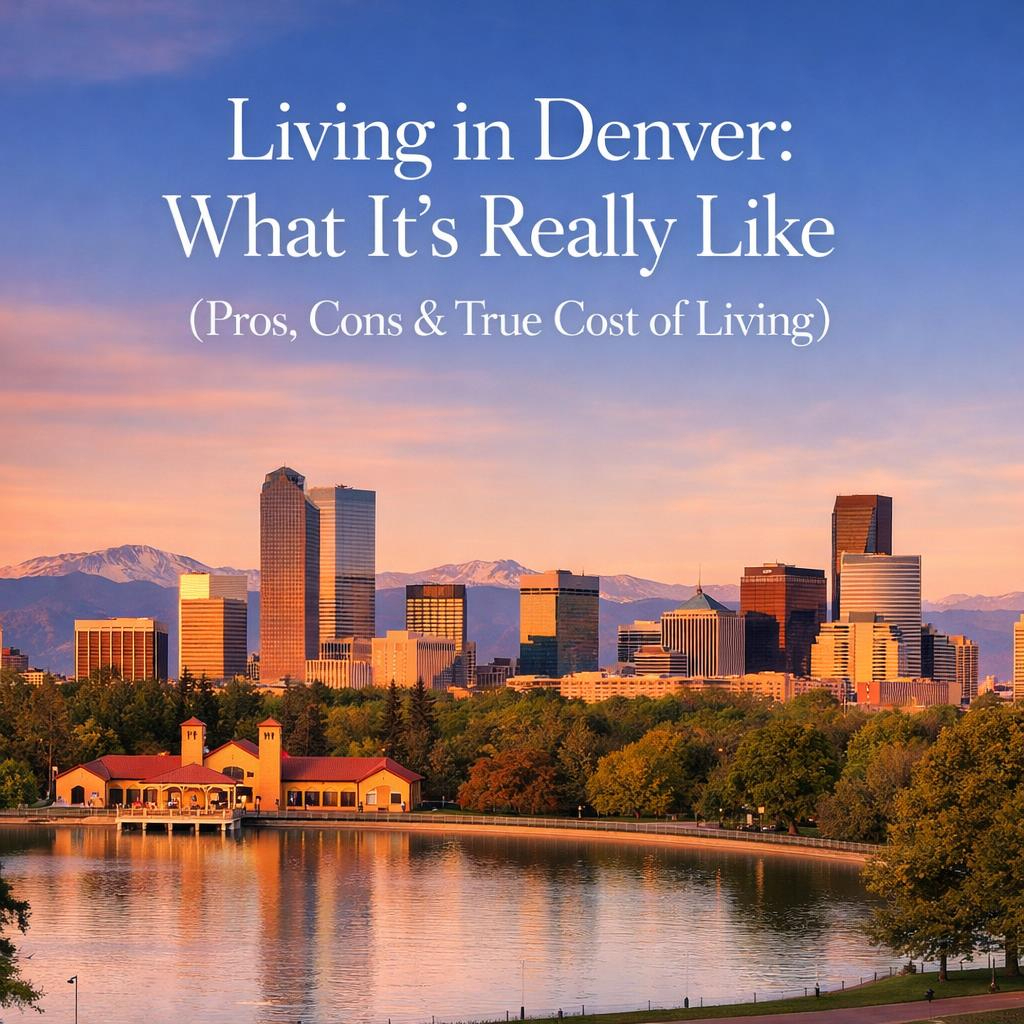
Living in Denver today means navigating a city that is still growing, but no longer sprinting. Housing is expensive by national standards, daily costs add up faster than many newcomers expect, and yet the city continues to attract people who value access to jobs, mountains, and a major metro without coastal chaos. Denver’s cost of living now sits roughly 9% above the national average, with housing about 22% higher than the U.S. baseline, while utilities run modestly lower than average. Understanding what Denver living really costs—and what you get for it—is essential to making a sound long‑term real estate decision.
What follows looks at the pros, cons, and true cost of living in Denver through a practical, ownership-focused lens.
Housing in Denver: Prices, Renting, and Buying
Housing is the single largest driver of Denver’s higher cost of living.
Current home prices and what they mean
Across the Denver metro, recent data show:
- Metro Denver’s overall median home price is around $595,000–$599,000.
- Detached single‑family homes often fall in the mid‑$600,000s, while condos and townhomes average roughly $390,000–$400,000.
- Within the city, median prices hover near $580,000, with surrounding cities like Lakewood and Aurora in a similar band, and Golden higher around $700,000.
Denver’s prices have cooled slightly from 2022’s peaks, with some sources noting a 2–5% pullback from the absolute highs, but the market remains expensive relative to both Colorado and the U.S. overall. For buyers, that means the “discount” off peak is modest; this is still a major‑metro pricing environment.
From a real estate perspective:
- Expect to trade square footage and lot size for location if you want shorter commutes or established neighborhoods (e.g., central Denver, Littleton, Arvada).
- In a more balanced market—roughly 3–4 months of inventory—well‑priced homes still sell, but buyers have more room to negotiate inspection items, seller credits, and closing timelines.
Renting versus buying
On the rental side:
- Average rent for a one‑bedroom in Denver is around $1,900/month, with two‑bedrooms closer to $2,400/month, especially in central locations.
- ApartmentList estimates a median one‑bedroom rent around $1,494, with total baseline living expenses for a renter (excluding childcare and extras) in the low‑$30,000s per year.
For many households, that math is close to an entry‑level mortgage payment once you factor in today’s interest rates, property taxes, and insurance. The decision often comes down to stability and time horizon: if you plan to stay 5–7+ years and choose a resilient neighborhood, ownership can offer better long‑term cost control and equity growth than chasing rent hikes.
The True Cost of Living in Denver
Cost of living beyond the mortgage
A recent cost-of-living analysis shows:
- Overall cost of living in Denver is about 5% higher than the Colorado average and 9% above the national average.
- Housing is 7% higher than the Colorado average and 22% higher than the U.S. average.
- Utilities run about 11% lower than the national average, while groceries are roughly 2% higher.
ApartmentList’s breakdown suggests a typical renter’s core annual expenses might look like:
- Rent (median one‑bedroom): ≈ $17,900/year
- Groceries: ≈ $4,900/year
- Healthcare: ≈ $3,000/year
- Transportation: ≈ $8,000/year
That brings basic costs to roughly $32,800 per year, before utilities, childcare, debt payments, or discretionary spending. For owners, add several thousand more for property taxes, homeowner’s insurance, HOA dues where applicable, and ongoing maintenance.
Transportation, commuting, and geography
Denver’s cost profile is heavily influenced by how and where you commute:
- Transportation costs for Denver residents are estimated at 8–16% above the national average, depending on neighborhood and driving habits.
- Many buyers choose inner‑ring suburbs (Lakewood, Wheat Ridge, Littleton, parts of Aurora) to balance housing cost, access to light rail or major arterials, and reasonable commute times.
The real-world implication is that a slightly more expensive but better‑located home can be cheaper over time than a cheaper house 20 miles farther out, once you price in fuel, vehicle wear, and time spent on I‑25 or C‑470.
Pros of Living in Denver (from an Ownership Perspective)
1. Diverse, resilient housing demand
Forecasts for 2025 show Denver operating as a relatively balanced market: modest price growth (2–3% year‑over‑year), inventory up, and days on market in the 30–45 day range. That reflects:
- A diversified job base (tech, healthcare, government, logistics) supporting steady housing demand.
- Population and job growth that is slower than early‑2020s peaks but still positive.
For owners, this environment favors:
- Long‑term holds with compounding appreciation, rather than short‑term speculation.
- Neighborhoods with strong fundamentals—schools, transit, and amenities—over trendy but unproven areas.
2. Utilities and energy efficiency can be managed
While housing is expensive, utilities are slightly cheaper than national norms. Colorado’s dry climate, abundant sunshine, and newer housing stock in many suburbs mean:
- South‑facing homes can use passive solar gain to cut winter heating bills.
- Many newer builds along the south and southeast metro (Highlands Ranch, Parker, parts of Aurora) include better insulation and high‑efficiency systems, lowering long‑run operating costs.
Thoughtful buyers factor in orientation, age, and build quality, not just price per square foot.
3. Strong long-term fundamentals for owners
Statewide forecasts continue to project:
- Low unemployment (around 3.5%) and wage growth near 4%, both supportive of continued home demand.
- A market shifting from a strong seller’s market toward a more balanced environment, not a severe downturn.
For owners planning to live in Denver or the suburbs for a decade or more, those fundamentals support a strategy built on:
- Buying in locations that will still be desirable under a range of interest-rate and economic scenarios.
- Prioritizing condition, layout, and neighborhood quality over maximum size.
Cons and Tradeoffs of Living in Denver
1. Housing affordability and income pressure
Multiple analyses point out that Denver’s home prices and rents increasingly require a higher household income to feel “comfortable,” with some local estimates suggesting six‑figure incomes to own and save comfortably. Combined with:
- Higher transportation costs than many similarly sized metros,
- And rising mortgage rates in recent years,
this creates real pressure on first‑time buyers and households carrying student loans or other debt.
Practically, that means:
- Many buyers compromise on size, condition, or distance from downtown.
- Others look at townhomes and condos as long‑term homes, not just short‑term stepping stones.
2. Microclimates and maintenance surprises
Denver’s Front Range climate is hard on houses:
- Frequent freeze–thaw cycles and hail events drive recurring roof and exterior repairs.
- Insurance premiums and deductibles have risen as carriers respond to storm losses and fire risk in surrounding counties.
Buyers who do not budget for higher maintenance and insurance costs can feel blindsided. In practice, it is wise to:
- Build a realistic annual maintenance reserve (often 1–2% of home value).
- Prioritize properties with newer roofs, good drainage, and updated mechanicals—even if cosmetics are dated.
3. A “balanced” market that still behaves like a big city
While recent data show a more balanced market—around 3–4 months of inventory and more negotiation room —Denver is still a competitive major metro. That often means:
- Premium neighborhoods (Cherry Creek, Washington Park, Highlands) still command bidding wars for well‑presented listings.
- Buyers need to be prepared with strong pre‑approval, realistic expectations, and a clear strategy.
For sellers, the implication is that:
- Overpricing will sit; the market rewards accurate pricing and good preparation, not wishful thinking.
How to Think About the “True Cost” of Living in Denver
For a typical owner-occupant, the true cost of living in Denver is the sum of:
- Housing: mortgage or rent, taxes, insurance, and HOA (where applicable).
- Operating costs: utilities, commuting, and maintenance in a hail- and snow-prone climate.
- Opportunity costs: your time in traffic versus proximity to work, schools, or transit.
Given a median home price around $580,000–$599,000, a buyer putting 10–20% down at prevailing rates can expect a total monthly housing cost (PITI + HOA in many areas) that easily reaches or exceeds the $3,500–$4,500 range for many properties. The decision is less “Is Denver cheap?” (it isn’t) and more:
- “Does this particular neighborhood and home justify its cost over the next 7–10 years, given my income, commute, and plans?”
Well‑chosen neighborhoods—inside the city or in mature suburbs like Littleton, Arvada, or parts of Centennial—often answer that question with stable or gently rising values and consistently high demand.
A Calm, Practical Way to Approach Denver
For serious, thoughtful buyers and sellers, a grounded approach works best:
- Treat Denver as a long-term hold market with modest but resilient appreciation, not a get‑rich‑quick environment.
- Focus on micro‑location and livability—schools, commute routes, parks and trails, noise, and plowing patterns—rather than absolute cheapest price.
- Build a budget that realistically includes maintenance, insurance, and commuting, not just the mortgage.
Done well, that approach turns a higher‑cost city into a stable, wealth‑building home base.
For a detailed, numbers‑driven look at how Denver’s housing costs, neighborhood differences, and current market balance line up with your specific goals, reach out for a personalized Colorado real estate strategy. Whether you are buying, selling, or relocating to the Denver metro, a tailored analysis can clarify what “living in Denver” will really cost—and what it can return over time.



First-Time Homebuyer Guide to Denver
This guide is part of our complete Denver Real Estate Guide → [Denver Real Estate Guide] First-time homebuyers in Denver face a balanced market where median prices hover around $575,000-$599,000, inventory provides real choices, and mortgage rates near 6.25% reward preparation over rushing. Neighborhoods like Capitol Hill and Congress Park offer walkable entry points under $500,000…


New Construction vs Resale Homes in Denver
This guide is part of our complete Denver Real Estate Guide → [Denver Real Estate Guide] Choosing between new construction and resale homes in Denver hinges on balancing upfront warranties against proven resilience to the city’s hail storms, freeze-thaw cycles, and I-25 commutes. New builds in areas like Five Points or RiNo offer modern layouts and…

HOA Rules You Should Know Before Buying in Denver
This guide is part of our complete Denver Real Estate Guide → [Denver Real Estate Guide] Homeowners associations govern about 40% of Denver’s housing stock, particularly in condo buildings, townhome developments, and newer neighborhoods within city limits like Capitol Hill conversions and Five Points infill projects. These rules cover everything from exterior paint colors to parking…
 Mile High Home Group - Welcome to Denver
Leave a comment