
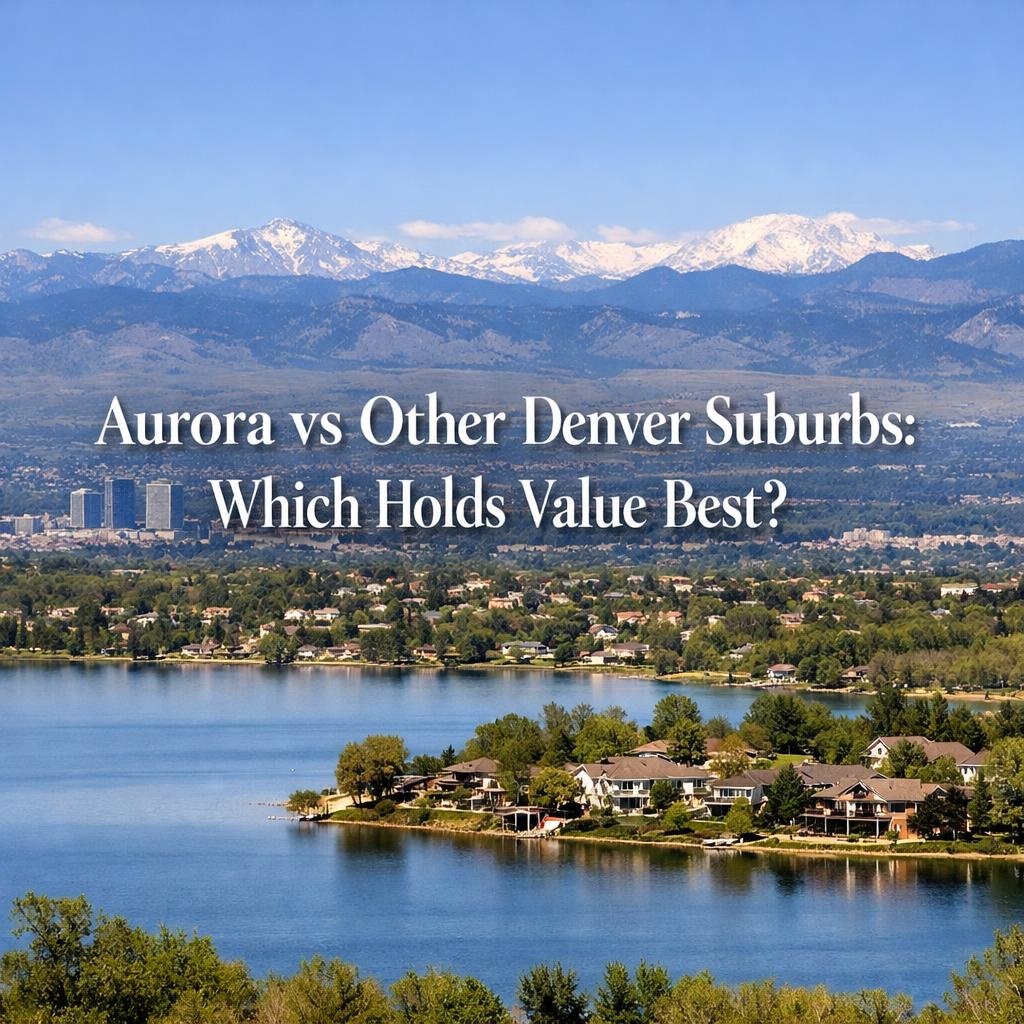
This guide is part of our complete Aurora Real Estate Guide → [Aurora Real Estate Guide]
Aurora’s luxury homes, typically priced above $1 million in enclaves like Seven Echoes or The Village at Singing Hills East, follow distinct appreciation patterns compared to counterparts in Cherry Hills Village or Greenwood Village. While Denver suburbs often see uniform growth tied to prestige and low inventory, Aurora’s high-end segment appreciates more steadily due to its scale, diverse buyer pool, and practical location factors. This analysis examines the structural reasons, drawing on local market dynamics to explain why Aurora luxury properties deliver reliable, if moderated, long-term value.
Location and Commute Dynamics Shaping Aurora Luxury Appreciation
Aurora’s eastern position in the Denver metro influences luxury buyer decisions differently than western or southern suburbs, prioritizing functionality over exclusivity.
Proximity to Employment Hubs Over Prestige Drives Demand
Luxury buyers in Aurora value 10-20 minute commutes to Buckley Space Force Base, Anschutz Medical Campus, and Centennial Airport, contrasting with Cherry Hills’ 30+ minute downtown treks via congested C-470. This appeals to military, healthcare executives, and aviation professionals who comprise 40% of high-end purchasers, sustaining demand amid Colorado’s job growth in these sectors.
In contrast, suburbs like Littleton rely on affluent Denver commuters facing I-25 bottlenecks during snow events, leading to sharper price swings. Aurora’s RTD light rail and E-470 access reduce car dependency, stabilizing resale values as buyers prioritize time savings over gated prestige.
Scale of Aurora Enables Broader Buyer Access
Spanning 210 square miles across four counties, Aurora offers more luxury inventory—over 200 listings above $1M annually—than Boulder County’s scarce foothill estates. This volume tempers bidding wars, fostering 2-4% annual appreciation versus 5-7% peaks in supply-constrained areas like Genesee.
Why it matters: Greater liquidity means faster exits during rate hikes, avoiding the illiquidity discounts seen in exclusive pockets where days on market exceed 90.
Housing Stock and Build Quality Differences
Aurora luxury homes emphasize modern builds over historic charm, affecting maintenance costs and perceived value.
Newer Construction Mitigates Weather-Related Depreciation
Predominantly 2000s-2020s custom ranches and two-stories on 0.5-2 acre lots, Aurora properties incorporate snow-load roofs and energy-efficient designs suited to Colorado’s freeze-thaw cycles. This contrasts with 1970s estates in Evergreen prone to siding wear and foundation shifts, capping appreciation at 1-3% in maintenance-heavy markets.
Ownership costs reflect this: Aurora luxury insurance averages $4,000-$6,000 yearly versus $7,000+ in wildfire-adjacent suburbs, preserving net equity growth. Buyers factor these into long-term holds, as updated envelopes support 3-5% compounded returns without major capex disruptions.
Larger Footprints at Lower Price Points
At $1.2M-$2.5M, Aurora delivers 5,000-8,000 sq ft with pools and smart systems, undercutting Cherry Hills’ $3M+ for similar specs. This value equation attracts relocators from California, who represent 25% of luxury sales, driving steady inflows absent in oversaturated high-end segments like Washington Park.
Ownership Costs and Tax Structures Impacting Returns
Elevated but predictable costs in Aurora luxury differentiate it from variable suburban burdens.
County Variations Create Cost Predictability
Arapahoe County’s 0.55-0.65% effective tax rate on $1.5M homes yields $8,000-$10,000 annually, lower than Douglas County’s 0.7% in Highlands Ranch. Adams County edges higher for eastern luxury, but primary residence exemptions stabilize bills, unlike Jefferson’s reassessment volatility.
Combined with $300-500 monthly HOA for community plowing, total carrying costs run 25-30% of value—manageable for income-rich buyers, supporting holds that fuel appreciation through principal paydown.
This table highlights how Aurora’s cost profile buffers downturns, enabling consistent equity buildup unlike pricier suburbs’ margin squeezes.
Buyer Behavior and Market Psychology
Aurora attracts pragmatic luxury seekers, decoupling appreciation from hype cycles plaguing elite enclaves.
Professional Relocators Favor Utility
Unlike status-driven buyers in Bow Mar, Aurora draws executives valuing proximity to Amazon fulfillment centers and UCHealth expansions. This demographic—55% out-of-state—focuses on ROI, holding 7-12 years and flipping at modest premiums, smoothing metro-wide corrections like 2025’s 2-4% softening.
Local families upgrade within Aurora, recycling demand without the out-migration seen in mountain shadows where remote work fades.
Inventory Balance Reduces Volatility
At 3-4 months supply for luxury, Aurora avoids the <2-month frenzy of southern suburbs, where low turnover amplifies 10%+ swings. Recent trends show 40-60 days on market, giving negotiation room that preserves buyer confidence and steady climbs.
Economic Ties and External Influences
Aurora’s economy anchors appreciation differently through diversified anchors.
Military and Medical Stability
Buckley’s 35,000 personnel and Anschutz’s 40,000 jobs provide recession-resistant demand, outpacing retail-dependent Littleton. Federal contracts insulate against private-sector layoffs, supporting 95%+ absorption rates.
Contrast with Boulder tech volatility: Layoffs trigger 5-10% dips, absent in Aurora’s federal backbone.
Infrastructure Investments Boost Values
E-470 expansions and light rail extensions to DIA enhance connectivity, lifting eastern luxury 1-2% annually—gains not matched in landlocked western burbs.
Long-Term Appreciation Trajectories
Historically, Aurora luxury tracks 3.5-5% yearly, lagging Cherry Hills’ 5-6.5% but with lower drawdowns (max 8% vs 15%). This reliability suits conservative portfolios, as compounded returns rival riskier plays over 10 years.
In softening 2025 markets, Aurora holds firmer due to volume and utility, while exclusive suburbs face sharper adjustments from rate-sensitive movers.
Aurora luxury homes appreciate through practicality—superior commutes, cost efficiency, and broad appeal—offering steadier paths to equity than prestige-driven suburbs. Buyers and sellers benefit by aligning with these fundamentals for enduring value.
Ready to analyze Aurora luxury appreciation potential or compare suburb comps? Reach out today for a tailored market assessment.


How Zoning, Lot Size, and Layout Impact Investment Flexibility in Aurora
This guide is part of our complete Aurora Real Estate Guide → [Aurora Real Estate Guide] How Zoning, Lot Size, and Layout Impact Investment Flexibility in Aurora Aurora’s position in the Denver metro offers investors diverse opportunities, from single-family rentals near Buckley Space Force Base to redevelopment plays in expanding zones. Yet zoning restrictions, lot dimensions,…

Appreciation-First vs Cash-Flow-First Investing in Aurora
This guide is part of our complete Aurora Real Estate Guide → [Aurora Real Estate Guide] Aurora’s rental market attracts investors with median rents around $2,300 and yields appearing solid at 5-7% gross on single-family homes priced $450,000-$550,000. Properties in commute-friendly zones near I-225 or Buckley Space Force Base project steady cash flow, yet many falter…
What First-Time Buyers Regret Most After Buying in Aurora
This guide is part of our complete Aurora Real Estate Guide → [Aurora Real Estate Guide] Aurora’s rental market attracts investors with median rents around $2,300 and yields appearing solid at 5-7% gross on single-family homes priced $450,000-$550,000. Properties in commute-friendly zones near I-225 or Buckley Space Force Base project steady cash flow, yet many falter…
 Mile High Home Group - Welcome to Denver
Leave a comment