

This guide is part of our Current Real Estate Market Insights → [Current Real Estate Market Insights ]
Aurora’s housing market has shifted into a cautiously balanced phase: prices have eased from recent highs, inventory has improved, and buyers now have more time and leverage—even as long‑term demand remains supported by job growth and relative affordability within the Denver metro. For serious buyers, sellers, and relocating homeowners, the key is understanding how these conditions change negotiation dynamics, ownership costs, and long‑term value, rather than focusing on headline price changes alone.
Aurora real estate market at a glance
Aurora’s housing market is best described today as “somewhat competitive but stabilizing,” with a mix of modest price softening and longer days on market. Recent data shows median sale prices in the mid‑$400,000s to upper‑$400,000s, down a few percentage points year over year in some reports but still well above pre‑pandemic levels.
Homes in Aurora now take longer to sell on average, with recent figures showing typical days on market around five to eight weeks, compared with roughly a month a year earlier. The practical takeaway is that the market is no longer defined by extreme urgency; both sides have room for more deliberate decision‑making without signaling distress.
Why the “balanced but cautious” phase matters
A more balanced market changes who has leverage and how it should be used. Buyers can negotiate more confidently on price, inspection items, and concessions, while sellers must be sharper on pricing and presentation to stand out among a larger pool of listings.
For long‑term owners, this environment typically favors disciplined decision‑making over speculation. People who buy or sell based on their real housing needs and solid underwriting, rather than short‑term price swings, are better positioned to benefit from Aurora’s continued role as a relatively affordable, job‑supported suburb in the Denver metro.
Current pricing trends in Aurora and what they signal
Several reputable market trackers show that Aurora’s prices have moderated after years of strong gains, with estimates of modest annual declines or flat performance in 2025 following earlier increases. For example, median sale prices have hovered in the mid‑$400,000s, with some sources noting a roughly 4–7% year‑over‑year dip, while longer‑range forecasts still point to low‑single‑digit appreciation ahead.
Importantly, per‑square‑foot pricing has held relatively steady even as overall medians have wobbled, suggesting that the market is adjusting more through changes in mix—size, condition, and location—than a broad collapse in value. That nuance matters: it tells buyers and sellers that property‑specific factors now drive outcomes more than the “rising tide” of the last cycle.
Aurora versus the larger Denver metro
Compared with Denver proper and premium submarkets like Boulder, Aurora still offers a meaningful affordability discount while providing access to the same regional job base and transportation corridors. This relative value is one reason many Denver‑area buyers, including first‑time purchasers and move‑up families, continue to search within Aurora even when they work elsewhere in the metro.
Forecasts for the broader Denver‑Aurora region anticipate continued population growth toward roughly 3 million residents by the mid‑2020s, reinforcing long‑term housing demand. Aurora’s mix of established neighborhoods and large master‑planned communities positions it to absorb a meaningful share of that growth, particularly on the east and northeast sides of the metro.
Inventory, days on market, and leverage for buyers and sellers
Inventory in Aurora has increased from the ultra‑tight conditions of the early 2020s, with more active listings and a wider mix of price points and property types. At the same time, the pace of sales has slowed: homes now typically receive around two offers and take longer to go under contract than during the peak pandemic years.
For context, broader Denver‑Aurora data shows median days on market climbing into the 40–50‑day range in 2025, mirroring what buyers and sellers are experiencing in many Aurora neighborhoods. That shift gives buyers time to compare options and sellers more feedback from the market before making major price moves.
What this means if you are buying in Aurora
In practical terms, current Aurora conditions give serious buyers several advantages:
- More inventory means more choice in neighborhoods, school zones, and floorplans, particularly in east and southeast Aurora.
- Longer days on market often translate into increased willingness from sellers to consider concessions such as closing‑cost credits or rate buydowns.
- The moderate competitiveness—homes getting a couple of offers rather than a dozen—reduces the pressure to waive protections that matter long term, like inspections.
From an underwriting standpoint, Aurora’s pricing relative to income levels and rents can still make sense for buyers with a medium‑to‑long holding period, especially if they choose locations with strong connectivity to the Denver Tech Center, DIA, and central Denver.
What this means if you are selling in Aurora
For sellers, the key message is that the market will reward well‑prepared, properly priced homes but will no longer bail out listings that are sloppy or significantly overpriced. Median prices between roughly $450,000 and $500,000 reflect a stable mid‑market, but the spread in days on market—often 17 to 46 days or longer—shows how much strategy matters.
Serious sellers in Aurora should expect:
- Buyers to compare your home directly with similar options in nearby pockets of southeast Denver, Centennial, and Parker.
- Appraisers and buyers’ agents to lean heavily on recent sold data rather than 2021–2022 peak pricing.
- The possibility of strong activity for homes that are turnkey and accurately priced, and more resistance for properties with deferred maintenance or unrealistic list prices.
Neighborhood patterns, commute realities, and housing stock
One of Aurora’s defining characteristics is the diversity of its housing stock. There are older, centrally located neighborhoods like Aurora Hills and Mission Viejo with mature trees, mid‑century or 1970s‑era homes, and a wide range of remodeling levels. Farther east, newer master‑planned communities like The Aurora Highlands and Painted Prairie offer recently built homes, modern layouts, and extensive community amenities.
These differences in age, design, and infrastructure feed directly into long‑term ownership costs:
- Older homes often come with larger lots and established landscaping but may require substantial investment in roofs, windows, sewer lines, and mechanical systems over a 10‑ to 15‑year horizon.
- Newer builds frequently offer better energy efficiency, open‑concept layouts, and lower short‑term maintenance, but can carry higher HOA or metro district taxes that must be factored into the monthly budget.
Commute patterns also matter more today as buyers weigh total time and cost: Aurora’s appeal includes direct access to I‑225, I‑70, E‑470, and light rail connections that link into downtown Denver, the Tech Center, and DIA. For many relocating households, this combination of commute options and relatively lower home prices is what makes “Aurora real estate” an enduring search term.
Interest rates, affordability, and buyer psychology
Higher mortgage rates compared with the ultra‑low period of the early 2020s continue to shape buyer psychology in Aurora. Recent commentary places many buyers in a 6.5–7% rate environment, which can significantly change monthly payment and qualification thresholds. While that has cooled some speculative demand, it has not eliminated the need for housing among relocating professionals, growing families, and long‑term renters looking to stabilize housing costs.
This rate backdrop has a few important consequences:
- Buyers are more sensitive to total monthly obligation, including taxes, insurance, and HOA or metro district fees, not just principal and interest.
- Many owners with low‑rate mortgages are reluctant to move without a compelling reason, which can limit turnover in certain established neighborhoods even as new‑build areas expand.
- Rate buydowns and seller‑paid concessions have become a normal part of negotiation again, especially for homes that have been on the market longer than the local average.
For thoughtful buyers, this environment can be an opportunity to secure a well‑located home at a more rational price, with the understanding that refinancing may be an option in a future, lower‑rate cycle.
Visual snapshot: Aurora’s recent price path
The following chart illustrates an approximate trend in Aurora’s median sale price from 2023 through 2025, showing modest growth followed by a slight pullback rather than a dramatic correction.
Aurora, CO Median Home Sale Price Trend, 2023–2025 (Approximate)
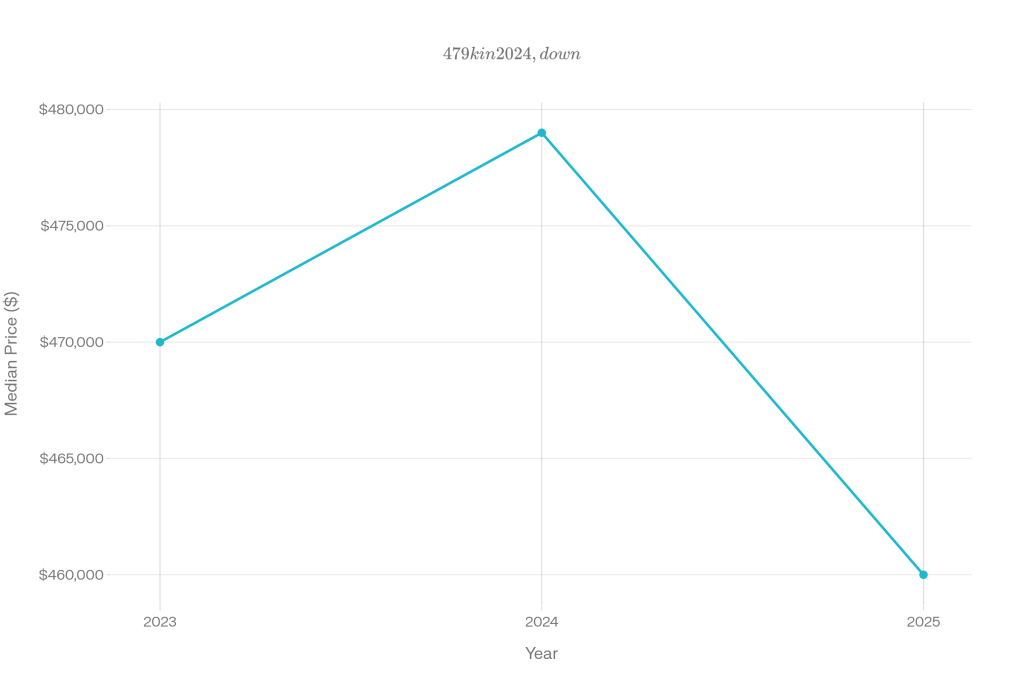
This pattern is consistent with what many local owners feel: values are no longer surging, but the market has not given back the substantial gains built up over the last decade.
Practical guidance for Aurora buyers
In Aurora’s current market, a deliberate, data‑driven approach serves buyers well:
- Start with a clear definition of non‑negotiables: commute corridor, school needs, and tolerance for maintenance in older versus newer construction.
- Compare total monthly costs across neighborhoods, paying close attention to special district taxes and HOA dues in newer master‑planned communities.
- Focus on homes where modest cosmetic improvements can create meaningful equity or enhanced livability, rather than stretching for fully renovated properties in marginal locations.
Because the market is “somewhat competitive” rather than frantic, buyers who are financially prepared and realistic on pricing can often negotiate favorable terms without sacrificing core protections.
Practical guidance for Aurora sellers
Owners considering a sale in Aurora should treat this as a professional exercise in positioning and pricing, not a test of how high the market will stretch. With median prices roughly in the $450,000–$500,000 range and days on market widening, the spread between strong results and disappointing outcomes usually comes down to strategy.
Effective seller strategies include:
- Anchoring list price to the last 60–90 days of truly comparable sales, adjusted honestly for condition and micro‑location.
- Addressing prominent deferred maintenance items before listing, especially those that would be obvious during showings or trigger inspection objections.
- Planning for negotiations around concessions and timing, recognizing that buyers are paying close attention to interest rates, closing costs, and inspection findings.
In this environment, it is still possible for well‑prepared homes to sell quickly and at strong prices, but that outcome is earned through preparation and realistic expectations rather than assumed.
Moving forward in the Aurora real estate market
Aurora’s current real estate landscape is neither overheated nor distressed; it is a maturing market where fundamentals—job growth, population trends, infrastructure, and property‑level quality—matter more than momentum alone. For buyers, sellers, and relocating homeowners who approach decisions with clear goals and an eye on long‑term value, the opportunities remain compelling, particularly given Aurora’s relative affordability within the Denver metro and its ongoing development on the east side.
If you are evaluating a purchase, sale, or relocation in Aurora or the broader Denver metro area, reach out directly to the authoring agent to review the latest local data, neighborhood‑specific trends, and a tailored strategy for your next move in this evolving market.



Why Pricing Strategy Matters More in a Balanced Market
This guide is part of our Current Real Estate Market Insights → [Current Real Estate Market Insights ] Centennial and the broader Denver metro have entered a balanced market where supply and demand align more closely, making precise pricing strategy the decisive factor between quick sales and prolonged listings. This equilibrium—marked by inventory levels up 25–40%…


How Interest Rate Movement Is Affecting Denver-Area Buyers
This guide is part of our Current Real Estate Market Insights → [Current Real Estate Market Insights ] Interest rate movements have reshaped the Denver-area housing market by altering affordability thresholds, slowing seller turnover, and handing buyers more leverage in negotiations. Current rates in the 6.5–7% range—more than double the lows of 2020–2021—directly impact monthly payments,…

Are Buyers or Sellers in Control Right Now? A Local Breakdown
This guide is part of our Current Real Estate Market Insights → [Current Real Estate Market Insights ] Denver metro real estate has reached a nuanced balance where neither buyers nor sellers hold outright control, but leverage tilts toward those who adapt to longer days on market, rising inventory, and selective pricing. This equilibrium matters because…
 Mile High Home Group - Welcome to Denver
Leave a comment