

This guide is part of our Current Real Estate Market Insights → [Current Real Estate Market Insights ]
Castle Rock’s real estate market reflects a maturing balance: inventory has risen notably from pandemic-era lows, allowing buyers more selection, while prices have stabilized after years of rapid gains, rewarding precision in pricing and preparation. For first-time home buyers navigating this south metro suburb, these conditions mean opportunities to secure entry-level properties without the frenzy of prior years, provided they follow a structured process attuned to local realities like commute access via I-25 and ownership costs shaped by Colorado’s climate. This guide outlines the step-by-step path tailored for Aurora-area first-timers eyeing Castle Rock, emphasizing why each phase matters for building long-term equity in a market where thoughtful decisions outpace speculation.
Understanding Castle Rock’s Current Inventory Landscape
Castle Rock, nestled along the I-25 corridor south of the Denver Tech Center, has seen active listings climb 20-30% year-over-year in recent reports, easing the supply crunch that defined 2021-2023. This uptick stems from more sellers entering the market as higher rates prompt realistic pricing, alongside new construction in areas like The Meadows and Phillip S. Miller Park vicinity. For first-time buyers, higher inventory translates to less competition on starter homes—typically 3-bedroom townhomes or single-family properties priced from the mid-$500,000s—allowing time for inspections and negotiations that protect against hidden costs.
Days on market have extended to 40-60 days on average, up from under 30 days previously, signaling buyer selectivity. In practical terms, this gives newcomers leverage to request seller concessions, such as closing-cost credits, which can offset the impact of 6-7% mortgage rates on monthly payments. Unlike denser urban pockets, Castle Rock’s housing stock favors ranch-style and two-story homes built post-1990, often with unfinished basements offering expansion potential—a key equity-builder for budget-conscious families.
Why Inventory Growth Benefits First-Time Buyers
More choices reduce the risk of settling for a mismatched property. Buyers can compare commute times to Centennial or Lone Tree (15-25 minutes north) against school quality in Douglas County District RE-1, without bidding wars inflating prices 10-15% over list. This shift matters because Castle Rock’s growth—fueled by remote work and proximity to outlets like Amazon and Lockheed Martin—supports steady appreciation, but only for well-selected homes in walkable enclaves or near Plum Creek trails.
Pricing Trends and Affordability Realities in Castle Rock
Median sale prices in Castle Rock hover in the upper-$500,000s to low-$600,000s, reflecting a 2-5% softening from 2024 peaks amid broader Colorado trends of modest declines. Per-square-foot values have stabilized around $250-280, driven by a mix of resales and new builds where builders offer incentives like rate buydowns to move inventory. For first-timers from Aurora, this represents a step up in quality—larger lots (0.15-0.25 acres common) and mountain views—but requires budgeting for Douglas County’s mill levy taxes (around 1.5-2% effective rate) and metro district fees in newer subdivisions.
Ownership costs extend beyond the mortgage: Colorado’s freeze-thaw cycles demand reserves for driveways and foundations, while south-facing exposure accelerates roof wear, adding $5,000-10,000 every 15-20 years. Buyers who factor these into pre-approval scenarios avoid post-purchase shocks, preserving cash for updates that boost resale value, such as energy-efficient windows suiting the high-altitude sun.
Step-by-Step Guide: Preparing Financially and Mentally
Step 1: Assess Readiness and Build a Local Network (Weeks 1-4)
Start by compiling your financial snapshot: debt-to-income ratio under 43%, 3-6 months’ reserves, and a credit score above 680 for optimal rates. Use Castle Rock-specific calculators to model payments including $400-800 monthly taxes/HOAs. Why this first? Pre-qualification signals seriousness to agents and prevents emotional decisions when touring inventory-heavy listings.
Connect with a Douglas County-savvy agent via REcolorado listings or local referrals—avoid national portals that overlook metro district nuances. Attend open houses in Terrain or Crystal Valley to gauge buyer behavior: note how longer market times lead to motivated sellers on 1,800-2,200 sq ft starters.
Step 2: Define Must-Haves Aligned with Castle Rock Dynamics (Weeks 2-6)
List non-negotiables: max 25-minute commute to DTC jobs, Douglas County schools, and low-maintenance exteriors (e.g., brick accents over all-stucco). Prioritize homes with main-floor offices for hybrid work, given Castle Rock’s remote-worker influx. This step matters because mismatched choices lead to resale losses; for instance, east-side properties near I-25 offer faster access but more traffic noise.
Set a realistic budget: $550,000-650,000 targets 55-65% of inventory, leaving room for 3-5% concessions. Research recent comps—last 90 days’ solds in your target zip (80104/80108/80109)—to understand pricing floors.
Step-by-Step Guide: Searching and Evaluating Properties
Step 3: Launch Targeted Searches and Virtual Tours (Weeks 4-8)
Leverage MLS filters for “Castle Rock first-time buyer homes”: 3+ beds, 2+ baths, under $650,000, built 2000+. With inventory up, set alerts for new listings in The Meadows (amenity-rich) or older pockets near Founders Village (value-oriented). Virtual tours save time, revealing red flags like undersized garages unfit for Colorado trucks/SUVs.
Visit 10-15 properties, noting weather impacts: south metro sun fades interiors faster, so check UV-tinted windows. Why deliberate pacing? Extended days on market mean sellers negotiate post-inspection, often covering $5,000-15,000 repairs.
Step 4: Conduct Thorough Due Diligence (Weeks 6-10)
Hire a local inspector familiar with high-plains soil shifts and radiant floor risks. Review seller disclosures for metro assessments (up to $2,000/year initially) and HOA rules on solar installs—a rising priority. Appraise commute realism: test rush-hour I-25 from Aurora (30-45 minutes) to confirm.
Run title searches for liens; in growing Castle Rock, utility easements affect basements. This phase protects equity: skipping it risks 5-10% value erosion from undisclosed issues.
Step-by-Step Guide: Negotiating and Closing
Step 5: Craft a Competitive Yet Protective Offer (Weeks 8-12)
Offer 98-102% of list on strong properties, requesting 45-day closing with inspection contingency. Include appraisal gap coverage up to 2%—common now with softening prices. Escalate selectively on low-inventory gems near Outlets at Castle Rock.
Negotiate post-inspection: leverage comps showing 3-5% reductions for dated kitchens. Why strategy here? Balanced markets favor buyers who signal readiness (large earnest money) without overpaying.
Step 6: Finalize Financing and Ownership Transition (Weeks 10-14)
Lock rates early; explore Colorado first-time programs like CHFA for down payment assistance (3-5% grants). Budget closing costs at 2-4% ($12,000-25,000). Walk through pre-closing, verifying fixes.
Post-closing, allocate 1% annually for reserves: snow removal tools, gutter guards for Front Range rains. This secures 7-10 year hold periods where appreciation compounds.
Visualizing Castle Rock’s Inventory and Price Balance
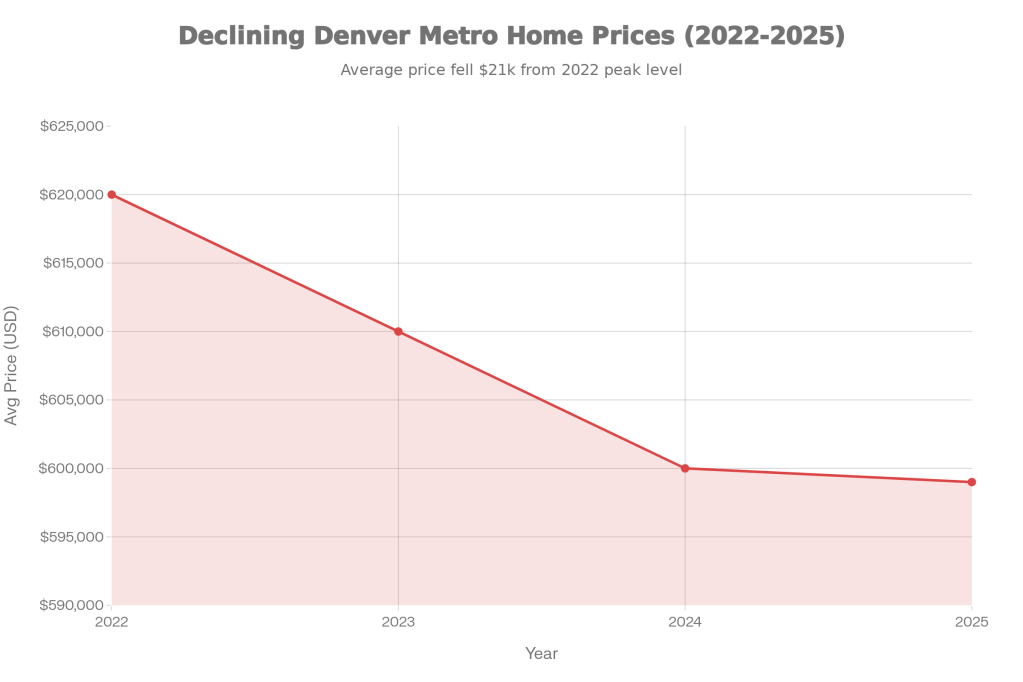
The chart below approximates Castle Rock’s median price stabilization amid rising inventory, using regional Denver-south trends: modest peak in 2024 followed by flattening
Castle Rock, nestled along the I-25 corridor south of the Denver Tech Center, has seen active listings climb 20-30% year-over-year in recent reports, easing the supply crunch that defined 2021-2023. This uptick stems from more sellers entering the market as higher rates prompt realistic pricing, alongside new construction in areas like The Meadows and Phillip S. Miller Park vicinity. For first-time buyers, higher inventory translates to less competition on starter homes—typically 3-bedroom townhomes or single-family properties priced from the mid-$500,000s—allowing time for inspections and negotiations that protect against hidden costs.
Days on market have extended to 40-60 days on average, up from under 30 days previously, signaling buyer selectivity. In practical terms, this gives newcomers leverage to request seller concessions, such as closing-cost credits, which can offset the impact of 6-7% mortgage rates on monthly payments. Unlike denser urban pockets, Castle Rock’s housing stock favors ranch-style and two-story homes built post-1990, often with unfinished basements offering expansion potential—a key equity-builder for budget-conscious families.
Why Inventory Growth Benefits First-Time Buyers
More choices reduce the risk of settling for a mismatched property. Buyers can compare commute times to Centennial or Lone Tree (15-25 minutes north) against school quality in Douglas County District RE-1, without bidding wars inflating prices 10-15% over list. This shift matters because Castle Rock’s growth—fueled by remote work and proximity to outlets like Amazon and Lockheed Martin—supports steady appreciation, but only for well-selected homes in walkable enclaves or near Plum Creek trails.
Pricing Trends and Affordability Realities in Castle Rock
Median sale prices in Castle Rock hover in the upper-$500,000s to low-$600,000s, reflecting a 2-5% softening from 2024 peaks amid broader Colorado trends of modest declines. Per-square-foot values have stabilized around $250-280, driven by a mix of resales and new builds where builders offer incentives like rate buydowns to move inventory. For first-timers from Aurora, this represents a step up in quality—larger lots (0.15-0.25 acres common) and mountain views—but requires budgeting for Douglas County’s mill levy taxes (around 1.5-2% effective rate) and metro district fees in newer subdivisions.
Ownership costs extend beyond the mortgage: Colorado’s freeze-thaw cycles demand reserves for driveways and foundations, while south-facing exposure accelerates roof wear, adding $5,000-10,000 every 15-20 years. Buyers who factor these into pre-approval scenarios avoid post-purchase shocks, preserving cash for updates that boost resale value, such as energy-efficient windows suiting the high-altitude sun.
Step-by-Step Guide: Preparing Financially and Mentally
Step 1: Assess Readiness and Build a Local Network (Weeks 1-4)
Start by compiling your financial snapshot: debt-to-income ratio under 43%, 3-6 months’ reserves, and a credit score above 680 for optimal rates. Use Castle Rock-specific calculators to model payments including $400-800 monthly taxes/HOAs. Why this first? Pre-qualification signals seriousness to agents and prevents emotional decisions when touring inventory-heavy listings.
Connect with a Douglas County-savvy agent via REcolorado listings or local referrals—avoid national portals that overlook metro district nuances. Attend open houses in Terrain or Crystal Valley to gauge buyer behavior: note how longer market times lead to motivated sellers on 1,800-2,200 sq ft starters.
Step 2: Define Must-Haves Aligned with Castle Rock Dynamics (Weeks 2-6)
List non-negotiables: max 25-minute commute to DTC jobs, Douglas County schools, and low-maintenance exteriors (e.g., brick accents over all-stucco). Prioritize homes with main-floor offices for hybrid work, given Castle Rock’s remote-worker influx. This step matters because mismatched choices lead to resale losses; for instance, east-side properties near I-25 offer faster access but more traffic noise.
Set a realistic budget: $550,000-650,000 targets 55-65% of inventory, leaving room for 3-5% concessions. Research recent comps—last 90 days’ solds in your target zip (80104/80108/80109)—to understand pricing floors.
Step-by-Step Guide: Searching and Evaluating Properties
Step 3: Launch Targeted Searches and Virtual Tours (Weeks 4-8)
Leverage MLS filters for “Castle Rock first-time buyer homes”: 3+ beds, 2+ baths, under $650,000, built 2000+. With inventory up, set alerts for new listings in The Meadows (amenity-rich) or older pockets near Founders Village (value-oriented). Virtual tours save time, revealing red flags like undersized garages unfit for Colorado trucks/SUVs.
Visit 10-15 properties, noting weather impacts: south metro sun fades interiors faster, so check UV-tinted windows. Why deliberate pacing? Extended days on market mean sellers negotiate post-inspection, often covering $5,000-15,000 repairs.
Step 4: Conduct Thorough Due Diligence (Weeks 6-10)
Hire a local inspector familiar with high-plains soil shifts and radiant floor risks. Review seller disclosures for metro assessments (up to $2,000/year initially) and HOA rules on solar installs—a rising priority. Appraise commute realism: test rush-hour I-25 from Aurora (30-45 minutes) to confirm.
Run title searches for liens; in growing Castle Rock, utility easements affect basements. This phase protects equity: skipping it risks 5-10% value erosion from undisclosed issues.
Step-by-Step Guide: Negotiating and Closing
Step 5: Craft a Competitive Yet Protective Offer (Weeks 8-12)
Offer 98-102% of list on strong properties, requesting 45-day closing with inspection contingency. Include appraisal gap coverage up to 2%—common now with softening prices. Escalate selectively on low-inventory gems near Outlets at Castle Rock.
Negotiate post-inspection: leverage comps showing 3-5% reductions for dated kitchens. Why strategy here? Balanced markets favor buyers who signal readiness (large earnest money) without overpaying.
Step 6: Finalize Financing and Ownership Transition (Weeks 10-14)
Lock rates early; explore Colorado first-time programs like CHFA for down payment assistance (3-5% grants). Budget closing costs at 2-4% ($12,000-25,000). Walk through pre-closing, verifying fixes.
Post-closing, allocate 1% annually for reserves: snow removal tools, gutter guards for Front Range rains. This secures 7-10 year hold periods where appreciation compounds.
Visualizing Castle Rock’s Inventory and Price Balance
The chart below approximates Castle Rock’s median price stabilization amid rising inventory, using regional Denver-south trends: modest peak in 2024 followed by flattening. (Adapted for local context from metro data.)
Denver Metro Average Home Price Trend, 2022–2025 (Approximate)
Homes priced realistically sell faster, underscoring preparation’s role for first-timers.
Neighborhood Insights for First-Time Buyers
East Castle Rock (near I-25) suits Aurora commuters with townhomes $450,000-550,000 and quick DIA access. West side (The Meadows) offers family lots $600,000+ with trails, but higher HOAs. Older inventory near downtown provides character homes needing updates—ideal for sweat-equity builders. Commutes define value: under 30 minutes to DTC preserves work-life balance amid hybrid shifts.
Common Pitfalls and How to Avoid Them
First-timers overlook metro taxes inflating payments 15-20%; model full PITI early. Emotional bids ignore comps—stick to data. Weather resilience: prioritize insulated garages for vehicle protection. Long-term: choose expandable layouts for family growth, as Castle Rock’s schools draw relocators.
Final Step-by-Step Breakdown: From Vision to Keys
- Financial Audit (Days 1-14): Gather docs, pre-approve, budget with local taxes/HOAs.
- Agent and Criteria (Days 15-30): Hire local expert, define search parameters.
- Market Dive (Days 31-60): Tour 20+ homes, track inventory shifts.
- Deep Analysis (Days 61-75): Inspect top 3-5, review disclosures/comps.
- Offer and Negotiate (Days 76-90): Submit data-backed bid, close repairs.
- Close and Settle (Days 91-105): Fund, walk-through, plan Year 1 maintenance.
Navigating Castle Rock as an Aurora First-Time Buyer
Castle Rock’s inventory expansion and price equilibrium create a buyer-friendly window for first-timers transitioning from Aurora rentals or condos, blending suburban scale with Denver-metro access. Disciplined steps ensure decisions align with enduring value—functional homes in demand corridors that weather economic cycles.
Reach out to the authoring agent today for a personalized Castle Rock market analysis, comp review, and step-by-step walkthrough tailored to your finances and timeline.



Why Pricing Strategy Matters More in a Balanced Market
This guide is part of our Current Real Estate Market Insights → [Current Real Estate Market Insights ] Centennial and the broader Denver metro have entered a balanced market where supply and demand align more closely, making precise pricing strategy the decisive factor between quick sales and prolonged listings. This equilibrium—marked by inventory levels up 25–40%…


How Interest Rate Movement Is Affecting Denver-Area Buyers
This guide is part of our Current Real Estate Market Insights → [Current Real Estate Market Insights ] Interest rate movements have reshaped the Denver-area housing market by altering affordability thresholds, slowing seller turnover, and handing buyers more leverage in negotiations. Current rates in the 6.5–7% range—more than double the lows of 2020–2021—directly impact monthly payments,…

Are Buyers or Sellers in Control Right Now? A Local Breakdown
This guide is part of our Current Real Estate Market Insights → [Current Real Estate Market Insights ] Denver metro real estate has reached a nuanced balance where neither buyers nor sellers hold outright control, but leverage tilts toward those who adapt to longer days on market, rising inventory, and selective pricing. This equilibrium matters because…
 Mile High Home Group - Welcome to Denver
Leave a comment