

This guide is part of our Current Real Estate Market Insights → [Current Real Estate Market Insights ]
Denver’s housing market has shifted from a frenzied, seller‑dominated environment to a more balanced landscape where pricing, condition, and strategy matter more than ever. For serious buyers, sellers, and relocating homeowners, the key today is not timing the market perfectly but understanding how this new equilibrium changes risk, leverage, and long‑term value.
Where the Denver market stands now
The Denver metro market has cooled from its 2021–2022 peak but remains fundamentally resilient, supported by job growth, in‑migration, and limited developable land in many core areas. Inventory has increased meaningfully compared to a few years ago, giving buyers more choice and forcing sellers to compete on price, presentation, and terms.
The broader Colorado market has seen some of the highest active‑listing levels in a decade, a sign that the days of automatic multiple offers on almost every listing are over. Yet Denver continues to outperform many regions in transaction volume and stability, reflecting its role as the employment and population hub of the Front Range.
Price trends and what they actually mean
Average and median prices have softened slightly from the top, with many estimates suggesting a 3–5% pullback from 2022 highs rather than a deep correction. In practical terms, this is a transition from extreme exuberance to a more rational pricing environment, not a collapse in values.
Denver’s median closed price at the end of 2024 hovered in the mid‑$500,000s to high‑$500,000s, depending on property type and submarket. For buyers, slight price relief and more inventory translate into improved negotiating power, particularly on homes that sit longer or need updating.
How higher rates reshaped buyer and seller behavior
Mortgage rates above prior ultra‑low levels have been the defining psychological force in the market, even more than prices themselves. Many existing owners are “locked in” to low‑rate loans, slowing new listings and keeping some would‑be sellers on the sidelines unless they have a strong reason to move.
For buyers, higher monthly payments have sharpened focus on:
- Commute time and access to major job centers like the Denver Tech Center and downtown
- Total cost of ownership, including utilities, insurance, and ongoing maintenance
- Layout and livability, since trading up again in a few years may be less attractive
As rates show signs of stabilizing rather than spiking, more buyers are re‑entering the market with a longer‑term view, treating the first purchase or move‑up decision as a 7–10 year choice instead of a short‑term stepping stone.
Inventory, days on market, and negotiating leverage
The most important shift for both sides of the table is the balance between inventory and demand. Across Colorado, active listings are up significantly from the ultra‑tight conditions of the pandemic years, and Denver is no exception.
What more inventory means for buyers
For buyers in Denver and suburbs like Highlands Ranch, more inventory and longer days on market mean:
- A wider range of neighborhoods and floorplans to choose from
- Less urgency to bid far over list price on day one
- More room to ask for inspection items, credits, or seller concessions
Highlands Ranch, for example, has seen inventory increase and days on market edge up, even as median prices have wobbled slightly. The practical implication is that well‑informed buyers can be selective, targeting homes that either show real value or have clear upside through renovation.
What longer market times mean for sellers
For sellers, the increase in days on market is not just a statistic; it is a strategic problem. A home priced optimistically and launched without careful preparation now risks going stale, inviting low offers or forcing painful price reductions.
Serious sellers in this environment must:
- Price in line with recent, truly comparable sales rather than aspirational pandemic‑era numbers
- Present the home in move‑in‑ready condition where possible, or price honestly for needed work
- Understand that buyers have other options and will walk away from properties that feel overpriced relative to condition and location
Suburban dynamics: Highlands Ranch and the south metro
The south metro corridor—from Highlands Ranch to Lone Tree, Parker, and Castle Pines—remains one of the most instructive micro‑markets in the Denver area. These suburbs attract buyers who value established neighborhoods, strong schools, and relatively straightforward access to employment hubs via C‑470, I‑25, and light rail.
Highlands Ranch, with a median listing price around the upper‑$600,000s to low‑$700,000s, illustrates the current balance of softening prices and growing inventory. Forecasts point toward moderate appreciation over the next several years rather than aggressive growth, suggesting a market that rewards disciplined buying more than speculation.
For relocating buyers weighing Denver versus its suburbs, the choice is no longer simply “urban versus suburban lifestyle.” Commute patterns, topography, and school boundaries now intersect with budget and borrowing capacity to determine where value is most durable.
Weather, infrastructure, and housing stock realities
Colorado’s climate and built environment shape long‑term housing costs in ways that newcomers often underestimate. Most Denver‑area homes endure wide temperature swings, intense sun exposure, snow, and freeze‑thaw cycles, all of which influence maintenance needs.
In many Denver suburbs, housing stock ranges from 1970s‑era construction with looming system updates to newer master‑planned communities with higher HOA obligations but more energy‑efficient designs. Understanding these trade‑offs is crucial:
- Older homes may offer larger lots and mature trees but require more capital for roofs, windows, and mechanical systems.
- Newer builds often come with smaller lots but better insulation, modern layouts, and potentially lower utility costs.
In Highlands Ranch and similar communities, buyers also must factor in HOA dues, metro district taxes, and amenity costs as part of the total monthly obligation—not just principal and interest. Over a 10‑year horizon, those structural expenses can rival differences in purchase price.
Why the market feels “steady but cautious”
A useful way to think about the Denver housing market today is “steady but cautious.” The region benefits from a diversified job base, a continuing influx of new residents, and a constrained geography that limits unconstrained sprawl in some directions.
At the same time, both buyers and sellers are more deliberate:
- Buyers are stress‑testing monthly payments against potential rate changes and property‑tax adjustments
- Sellers are watching nearby listings closely and responding more quickly with price adjustments when the market offers feedback
- Investors are underwriting more conservatively, focusing on realistic rent growth rather than aggressive appreciation assumptions
Statewide data showing higher inventory and slower sales velocity reinforces this mood of caution, but Denver continues to be described as a market “finding its footing” rather than one in retreat.
Long‑term value in Denver’s changing market
For long‑term owners—whether primary‑residence buyers or buy‑and‑hold investors—the question is less “Will prices rise next year?” and more “Which properties will hold or grow their value through multiple cycles?”
In the Denver metro area, long‑term resilience generally favors homes that combine:
- Functional floorplans (especially well‑designed main‑floor living and work‑from‑home space)
- Reasonable commute access to major job centers and transit corridors
- Solid construction and well‑documented maintenance histories
- Locations with proven demand: established school districts, walkable pockets, or strong community amenities
Forecasts for the coming years suggest modest appreciation rather than rapid price spikes, with some models even projecting slight near‑term depreciation before a return to slow growth. That pattern typically rewards buyers who purchase quality assets at fair prices and hold them through several interest‑rate and economic cycles.
How buyers should approach the current Denver market
In this environment, serious buyers benefit from approaching the Denver metro market more like an investment committee than a shopper:
- Define non‑negotiables around commute, schools, and neighborhood type before touring homes.
- Compare total monthly cost across submarkets, including taxes, HOA or metro‑district fees, and realistic maintenance allowances.
- Focus on properties where minor improvements (paint, flooring, fixtures, landscaping) can significantly enhance livability and future resale.
Given the increase in inventory and longer days on market, buyers who are prepared and decisive still face competition on the best‑located, best‑presented homes—but they also have room to negotiate on those that are mispriced or poorly presented.
How sellers should recalibrate expectations and strategy
Sellers in Denver, Highlands Ranch, and surrounding suburbs must operate under different assumptions than in 2021. The market will still reward well‑positioned listings, but it no longer automatically forgives poor preparation or aggressive pricing.
A realistic strategy today includes:
- Pricing within a narrow band of recent comparable sales, adjusted for condition and micro‑location
- Addressing obvious deferred maintenance before hitting the market, especially items visible during showings and inspections
- Planning for concessions—whether rate buydowns, closing‑cost credits, or inspection credits—as part of the negotiation playbook
In many neighborhoods, the difference between a home that sells in a few weeks and one that lingers is not the broad market but the alignment between price, presentation, and buyer expectations.
Visual snapshot: Denver’s post‑peak price trend
The following chart illustrates an approximate trend of average home prices in the Denver metro area from 2022 through 2025, reflecting a gentle cooling rather than a sharp decline.
Denver Metro Average Home Price Trend, 2022–2025 (Approximate)
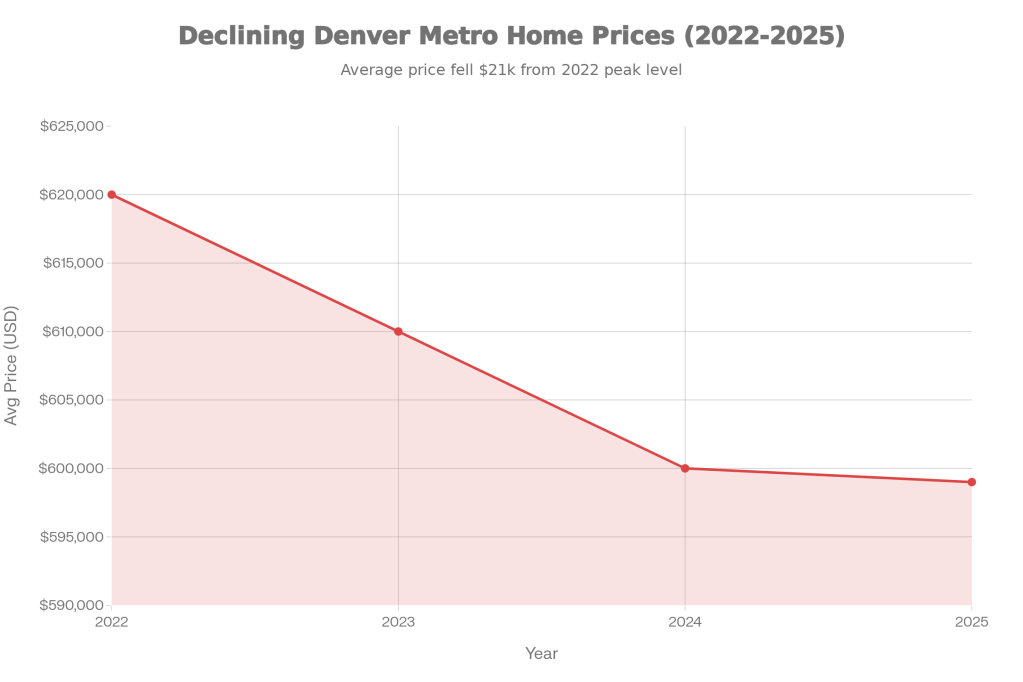
This pattern captures what many buyers and sellers feel on the ground: the market is no longer racing upward, but it is also not unwinding in a way that erases years of equity growth.
Moving forward in the Denver real estate market
Denver’s housing market has moved into a more disciplined, strategy‑driven phase where informed decisions matter more than simply being present when the market is rising. The combination of higher (but stabilizing) rates, greater inventory, and more cautious psychology has created opportunities for thoughtful buyers and serious sellers who are willing to adapt.
If you are considering buying, selling, or relocating into or within the Denver metro area—including Highlands Ranch and the surrounding suburbs—reach out directly to discuss your specific situation, timing, and goals so a tailored plan can be built around real market data rather than headlines..



Why Pricing Strategy Matters More in a Balanced Market
This guide is part of our Current Real Estate Market Insights → [Current Real Estate Market Insights ] Centennial and the broader Denver metro have entered a balanced market where supply and demand align more closely, making precise pricing strategy the decisive factor between quick sales and prolonged listings. This equilibrium—marked by inventory levels up 25–40%…


How Interest Rate Movement Is Affecting Denver-Area Buyers
This guide is part of our Current Real Estate Market Insights → [Current Real Estate Market Insights ] Interest rate movements have reshaped the Denver-area housing market by altering affordability thresholds, slowing seller turnover, and handing buyers more leverage in negotiations. Current rates in the 6.5–7% range—more than double the lows of 2020–2021—directly impact monthly payments,…

Are Buyers or Sellers in Control Right Now? A Local Breakdown
This guide is part of our Current Real Estate Market Insights → [Current Real Estate Market Insights ] Denver metro real estate has reached a nuanced balance where neither buyers nor sellers hold outright control, but leverage tilts toward those who adapt to longer days on market, rising inventory, and selective pricing. This equilibrium matters because…
 Mile High Home Group - Welcome to Denver
Leave a comment