

This guide is part of our Current Real Estate Market Insights → [Current Real Estate Market Insights ]
Highlands Ranch is in a period of orderly adjustment: prices are off their recent highs, inventory is higher than in the peak years, and well‑prepared buyers and sellers are both finding opportunities. For first‑time buyers who have mostly watched the market from the sidelines, this is a more workable environment—if they understand the weekly trends and follow a structured, step‑by‑step approach.
Weekly Highlands Ranch trends serious buyers should watch
Highlands Ranch home prices have edged down compared with a year ago, with recent reports showing a median sale price in the mid‑$600,000s to low‑$700,000s and a modest year‑over‑year decline of around 3–4%. Homes are also taking longer to sell, averaging roughly 46–53 days on market instead of about a month, indicating a cooler, more balanced market.
Active listings in Highlands Ranch are up compared with last year, with roughly 300+ homes on the market at recent counts—an increase of more than 10% year over year—giving buyers more choice by price range and neighborhood. At the same time, Douglas County overall shows more inventory and slightly longer marketing times, reinforcing that buyers have more leverage across the south‑metro area.
Why weekly shifts matter for first‑time buyers
For a first‑time buyer, weekly trends in new listings, price reductions, and days on market are more useful than one‑time headlines.
- When new listings slow and price reductions increase, sellers become more responsive to solid, clean offers.
- Longer days on market for specific homes often signal room to negotiate on price or concessions, especially in the 3.1 months of supply range recently reported.
Tracking these patterns keeps you grounded in the current Highlands Ranch real estate market, not last year’s conditions.
What the current Highlands Ranch market means for first‑time buyers
Recent data shows a median list price around $700,000 and a median sale price somewhat lower, with homes closing at about 97–99% of list on average. Price per square foot has been hovering around the mid‑$200s, with only a small year‑over‑year change, which suggests the market is adjusting through small pricing moves and longer days rather than a dramatic reset.
For first‑time buyers, this matters because:
- You no longer have to bid aggressively over list on day one to have a chance—only about 7–8% of Highlands Ranch homes are selling above list price right now.
- A significant share of homes (well over half in recent weeks) have taken at least one price drop before selling, which creates opportunity for patient, qualified buyers.
In short, this is a market where preparation and discipline can substitute for speed and risk‑taking.
Understanding Highlands Ranch: housing stock, commute, and ownership costs
Highlands Ranch is largely a master‑planned community, with most homes built from the 1980s onward and many in the 1990s and 2000s, which means a relatively consistent suburban style: two‑story and ranch homes, attached garages, and HOA‑maintained common areas. That age profile matters because many original roofs, windows, and mechanical systems have already been replaced—or are coming due—so buyers must look carefully at maintenance history during inspections.
The community is built around easy access to C‑470, Santa Fe, and I‑25, making it a practical base for commuting to the Denver Tech Center, downtown Denver, or even northern Colorado Springs. But that convenience comes with typical Highlands Ranch ownership costs: HOA dues, metro district or special assessments in some pockets, and property taxes that vary by neighborhood and school boundary. For a first‑time buyer, the lesson is simple: compare neighborhoods using total monthly cost, not just purchase price.
A step‑by‑step guide: from “thinking about it” to homeowner in Highlands Ranch
The rest of this post is structured as a practical roadmap for first‑time buyers specifically targeting Highlands Ranch, with weekly market conditions as the backdrop.
Step 1: Clarify your Highlands Ranch “must‑haves”
Before you look at interest rates or listings, define what you actually need from Highlands Ranch real estate:
- Commute realities: How often will you drive to the Tech Center, downtown, or DIA?
- School priorities: Douglas County’s schools are a major draw; specific elementary and high‑school boundaries affect both daily life and resale value.
- Housing type: Single‑family home versus townhome or condo, yard size, and whether you value newer construction over larger lots.
This step matters because Highlands Ranch offers a range of micro‑markets—from more affordable townhomes to larger, view‑oriented properties—and your short list will look very different depending on these priorities.
Step 2: Build a realistic budget around total monthly cost
With current Highlands Ranch median prices in the high‑$600,000s to low‑$700,000s, first‑time buyers need to approach financing methodically. Start with:
- What mortgage payment you can comfortably afford at today’s rates, not idealized future rates.
- Local property tax ranges in Douglas County and how they vary by subdivision.
- HOA dues and metro district charges, which are common in Highlands Ranch and can significantly change the monthly cost of similar‑priced homes.
The goal is not to stretch to the maximum lender approval but to target a price range where you can tolerate future tax changes, maintenance, and life events without being forced to sell.
Step 3: Get pre‑approved and time your search to the weekly rhythm
In a market where homes are selling in roughly 46–53 days on average, a strong pre‑approval still matters; competitive homes can move quickly even in a cooler environment. Pre‑approval demonstrates to Highlands Ranch sellers and their agents that you are serious and able to close.
Then, pay attention to the weekly cycle:
- New listings tend to cluster mid‑week and before weekends.
- Price reductions often batch early in the week, after seller feedback from the prior weekend.
- Some of the best opportunities are homes that have just crossed key thresholds—such as 30 or 45 days on market—without a serious offer.
Understanding this rhythm helps you focus your energy on weeks when new options appear or when existing listings are most negotiable.
Step 4: Use weekly data to choose neighborhoods and price bands
Highlands Ranch’s median list price around $700,000 masks meaningful differences between areas and price brackets. Weekly reports often show that:
- Some price bands (for example, entry‑level single‑family homes) move faster and closer to list price.
- Higher‑end or more dated homes may sit longer, resulting in more frequent price reductions.
Track:
- Median days on market by price range, where bar charts from local market reports highlight which brackets are cooling or tightening.
- The share of homes with recent price drops; a higher percentage suggests more negotiating room in that segment.
This allows you to aim slightly below the “headline” price range if you prefer less competition, or to compete more aggressively in a segment that aligns best with your goals.
Step 5: Tour strategically and evaluate condition, not just staging
When you tour Highlands Ranch homes, distinguish between cosmetic issues and structural or system concerns. Many homes built in the 1990s and early 2000s have benefited from at least one round of updates, while others are still essentially original.
Look closely at:
- Roof age, windows, furnace, A/C, and water heater.
- Evidence of deferred maintenance in exterior paint, decks, and landscaping.
- HOA coverage versus owner responsibility, especially in townhome and condo communities.
Because the market is no longer moving at lightning speed, you can afford to be selective and focus on homes where the underlying structure is sound, even if finishes can be improved over time.
Step 6: Craft offers informed by current Highlands Ranch statistics
Recent statistics show that:
- Homes in Highlands Ranch are selling for roughly 1–3% below list price on average.
- Only a small fraction of homes receive multiple offers above list, and those tend to be the best‑located, best‑prepared listings.
Use that context when writing offers:
- On fresh, well‑priced listings that match your criteria, coming in near list or slightly under—with strong terms and realistic inspection expectations—can be more effective than going low and losing the property.
- On homes that have been listed for more than 30–45 days or have taken price reductions, a more assertive offer below list, coupled with a strong pre‑approval and flexible closing, is often appropriate.
The goal is not to “win” every negotiation but to buy a good home at a fair number that reflects the actual weekly behavior of similar properties.
Step 7: Use inspections and due diligence to protect your long‑term value
With longer days on market and fewer bidding wars, Highlands Ranch buyers generally do not need to waive inspections to be competitive. Treat the inspection as both a risk‑management tool and a budget planning tool:
- Identify safety and major system issues that you may ask the seller to address or credit.
- Understand what maintenance items you will realistically face over the next 5–10 years, especially in older sections of Highlands Ranch.
Because the surrounding Douglas County market is also balanced—with median days on market around 60 days and stable rent levels—it is worth evaluating how your home would perform as a rental or resale in future scenarios.
Step 8: Close with a plan for the first years of ownership
Closing is not the end of the process; it is the start of your role as a Highlands Ranch homeowner. Given current market dynamics and modest recent price softening, smart first‑time buyers plan for:
- A multi‑year hold—often seven to ten years—to ride through interest‑rate and economic cycles.
- A maintenance reserve tailored to the age of the roof, systems, and major finishes.
- Periodic check‑ins on the local weekly and monthly market reports so you understand how your home fits into changing price and inventory patterns.
This mindset keeps you from over‑reacting to short‑term headlines and aligns your decisions with Highlands Ranch’s long‑term fundamentals.
Visual snapshot: a gentle weekly cooling trend
The chart below provides an illustrative view of how a weekly median list price trend in Highlands Ranch might look over a six‑month period—gradually stepping down from the low‑$700,000s toward the high‑$600,000s.
Illustrative Weekly Median List Price Trend – Highlands Ranch (Last 6 Months)
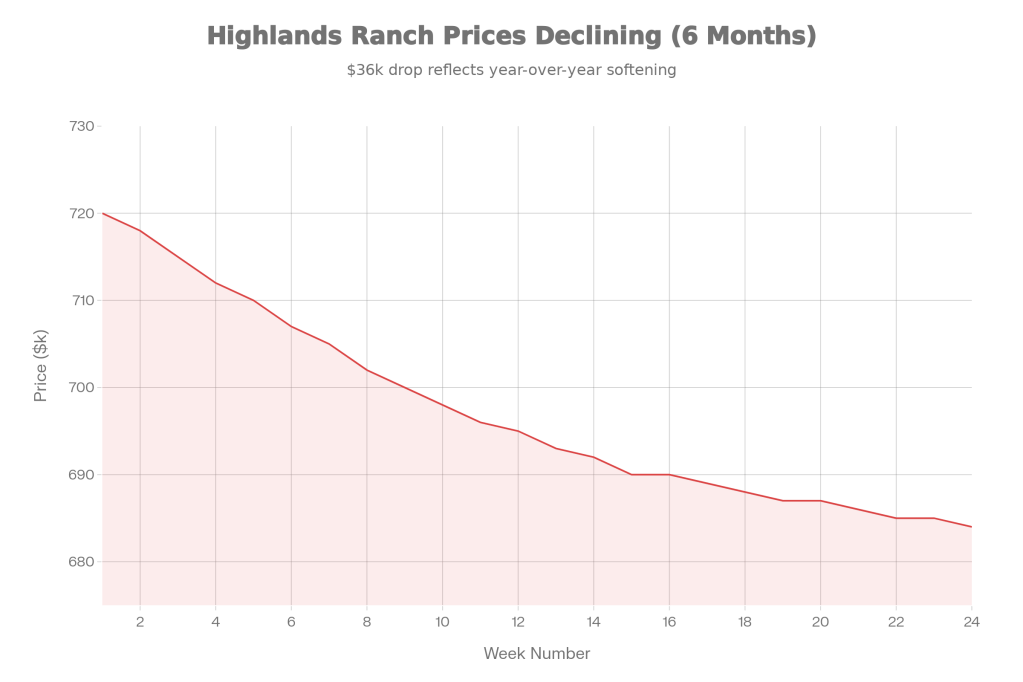
That kind of slow cooling is consistent with current reports: modest year‑over‑year price declines, longer days on market, and more frequent price adjustments, rather than abrupt corrections.
Final step‑by‑step breakdown: Highlands Ranch first‑time buyer process
To summarize the process from beginning to end in this specific market:
- Define your Highlands Ranch goals
- Build a budget around real local numbers
- Secure a strong pre‑approval
- Study weekly Highlands Ranch market reports
- Tour homes with an eye on condition and location
- Write offers grounded in real data
- Use inspection and appraisal to manage risk
- Close and implement a first‑year ownership plan
Highlands Ranch remains one of the Denver metro’s most sought‑after suburbs, and today’s conditions favor first‑time buyers who are organized, realistic, and informed by weekly trends rather than noise. If you are ready to take the next step—whether that is refining your budget, reviewing the latest Highlands Ranch housing data, or mapping specific neighborhoods to your goals—reach out directly to the authoring agent to walk through your options and build a customized plan from first conversation to keys in hand.



Why Pricing Strategy Matters More in a Balanced Market
This guide is part of our Current Real Estate Market Insights → [Current Real Estate Market Insights ] Centennial and the broader Denver metro have entered a balanced market where supply and demand align more closely, making precise pricing strategy the decisive factor between quick sales and prolonged listings. This equilibrium—marked by inventory levels up 25–40%…


How Interest Rate Movement Is Affecting Denver-Area Buyers
This guide is part of our Current Real Estate Market Insights → [Current Real Estate Market Insights ] Interest rate movements have reshaped the Denver-area housing market by altering affordability thresholds, slowing seller turnover, and handing buyers more leverage in negotiations. Current rates in the 6.5–7% range—more than double the lows of 2020–2021—directly impact monthly payments,…

Are Buyers or Sellers in Control Right Now? A Local Breakdown
This guide is part of our Current Real Estate Market Insights → [Current Real Estate Market Insights ] Denver metro real estate has reached a nuanced balance where neither buyers nor sellers hold outright control, but leverage tilts toward those who adapt to longer days on market, rising inventory, and selective pricing. This equilibrium matters because…
 Mile High Home Group - Welcome to Denver
Leave a comment