

This guide is part of our Current Real Estate Market Insights → [Current Real Estate Market Insights ]
Littleton’s real estate market has entered a phase where days on market (DOM) serve as the clearest indicator of shifting leverage, with homes now averaging 40–60 days from list to contract—up significantly from the sub-10-day frenzy of recent years. This extension matters because it gives thoughtful buyers time to evaluate options, negotiate terms, and avoid rushed decisions, while challenging sellers to refine pricing and presentation strategies. For first-time home buyers in Littleton, understanding DOM trends unlocks a structured path to ownership in a market that rewards preparation over speed.
Why Days on Market Trends Define Littleton’s Current Market
Longer DOM reflects a market transitioning from seller dominance to balance, driven by increased inventory and buyer selectivity amid stable but elevated interest rates. In Littleton, recent data points to median DOM climbing into the 30–50 day range across single-family homes and townhomes, compared with under 20 days in peak periods. This shift is not a signal of distress but an opportunity: buyers gain breathing room to assess commute realities, housing stock conditions, and total ownership costs specific to southwest Denver suburbs.
For first-time buyers, DOM trends explain why patience pays off. Homes lingering longer often prompt seller concessions, such as closing-cost credits or minor repairs, which directly lower effective purchase costs in a region where property taxes and maintenance add 20–30% to monthly payments beyond principal and interest.
Littleton DOM Compared to Denver Metro Neighbors
Littleton’s DOM exceeds central Denver’s but trails premium foothill areas, positioning it as a value-oriented submarket with strong fundamentals. Sub-neighborhoods like Ken Caryl and Columbine show slightly quicker turnover due to school appeal and C-470 access, while older pockets near downtown Littleton extend toward 50+ days if updates lag. Buyers targeting these variations can prioritize listings active 20+ days, where negotiation leverage peaks.
Step 1: Assess Your Readiness and Define Priorities
First-time buyers in Littleton start by building a financial and lifestyle foundation that withstands Colorado’s ownership realities—snow loads on roofs, high-altitude utility bills, and I-25/C-470 commute variability.
Secure pre-approval from a local lender familiar with metro district taxes in areas like Aspen Grove or Roxborough. Calculate total monthly outlay: expect $1,200–$1,800 beyond mortgage for taxes (1–1.5% of value), insurance (elevated due to weather exposure), and HOA fees in newer developments.
Narrow priorities: proximity to Littleton Public Schools, light rail access for downtown commutes (20–30 minutes), or larger lots in established 1970s–1980s neighborhoods. Document three non-negotiables—budget cap, bedroom count, garage size—to filter the MLS efficiently.
Step 2: Master the Littleton Market Through Data and Tours
Leverage longer DOM by studying trends via REcolorado or DMAR reports: track submarket medians ($550,000–$650,000), inventory levels (up 25–35% year-over-year), and DOM heat maps. Focus on properties listed 25+ days; these represent 40–50% of active inventory and yield concessions 2–3x more often.
Schedule 5–7 tours weekly, prioritizing:
- Homes with recent price reductions (5–7% off original ask), signaling seller motivation.
- Properties in seller-friendly pockets like Old Littleton or Bow Mar, balanced against value plays in Sterling Ranch.
- Mix of eras: 1980s ranch-styles for affordability versus 2010s builds for efficiency, weighing freeze-thaw repair cycles on older foundations.
Use tours to gauge condition red flags—settling cracks from expansive soils, outdated HVAC strained by dry winters—that inflate long-term costs.
Step 3: Navigate Financing and Rate Strategies
In a 6.5–7% rate environment, Littleton first-timers must optimize borrowing amid DOM-extended negotiations. Explore FHA loans (3.5% down) for lower barriers, but factor PMI until 20% equity.
Request seller-paid buydowns (1–2 points) on listings over 30 DOM—common now as sellers trade rate relief for closings. Compare lenders: local credit unions often beat national banks on Colorado-specific overlays like metro taxes.
Stress-test affordability: a $600,000 home at 6.75% yields $3,900 principal/interest; add $1,000 for taxes/insurance/HOA, targeting under 28% of gross income.
Step 4: Make Strategic Offers in a Longer-DOM Market
With DOM averaging 45 days, craft offers that protect while advancing: bid 2–5% below list on 30+ day listings, contingent on inspection and appraisal. Include escalation clauses capped at your max, escalation only if competing bids surface.
Common concessions in Littleton:
- $5,000–$10,000 closing credits for 40+ DOM homes.
- Repairs capped at 1.5% of price, focusing on structural items like roofs enduring heavy snow.
- Flexible possession for buyers needing bridge financing.
Avoid waiving inspections; Littleton’s clay soils and older plumbing demand thorough reviews.
Step 5: Conduct Due Diligence on Ownership Costs
Post-offer, scrutinize Littleton-specific expenses overlooked by out-of-state buyers. Review tax history via Arapahoe/Douglas County portals; metro districts in newer areas like Chatfield add $200–$400 monthly.
Inspect for weather impacts: sun-faded exteriors, ice dam risks on north-facing roofs. Get sewer scope ($300–$500) for 1980s homes prone to cast-iron failures. Quote HOA transfers and reserve studies—critical in governed communities like Governor’s Ranch.
Finalize insurance: shop carriers for wildfire-adjacent zones near Roxborough, where premiums run 20% above Denver averages.
Step 6: Close and Plan for Equity Building
At closing, verify walkthrough and fund escrow. Post-purchase, build equity via:
- Cosmetic updates (paint, fixtures) yielding 5–10% value lift in Littleton’s design-conscious market.
- Energy audits for rebates on insulation/windows, cutting $200+ annual utilities.
- Monitoring DOM trends quarterly to time future moves or refinances.
Neighborhood Insights Tied to DOM Trends
Littleton’s DOM varies by pocket, informing buyer strategy:
- Downtown Littleton/Littleton Village: 25–35 DOM; walkable appeal draws quicker offers but demands pristine updates.
- Southwest Littleton (Ken Caryl, Columbine): 35–45 DOM; family draw from schools offsets longer waits, favoring larger homes.
- Newer Developments (Sterling Ranch, Roxborough): 40–55 DOM; HOA perks help, but higher prices test first-timer budgets.
Commutes shape demand: C-470 users reach DTC in 15 minutes, while I-25 feeds downtown in 20–25, prioritizing east-west access over north-south.
Visualizing Littleton’s Days on Market Shift
Days on market in Littleton and the Denver metro have extended steadily, from under 20 in 2023 peaks to 40–60 today, correlating with inventory gains and price stabilization
Longer DOM reflects a market transitioning from seller dominance to balance, driven by increased inventory and buyer selectivity amid stable but elevated interest rates. In Littleton, recent data points to median DOM climbing into the 30–50 day range across single-family homes and townhomes, compared with under 20 days in peak periods. This shift is not a signal of distress but an opportunity: buyers gain breathing room to assess commute realities, housing stock conditions, and total ownership costs specific to southwest Denver suburbs.
For first-time buyers, DOM trends explain why patience pays off. Homes lingering longer often prompt seller concessions, such as closing-cost credits or minor repairs, which directly lower effective purchase costs in a region where property taxes and maintenance add 20–30% to monthly payments beyond principal and interest.
Littleton DOM Compared to Denver Metro Neighbors
Littleton’s DOM exceeds central Denver’s but trails premium foothill areas, positioning it as a value-oriented submarket with strong fundamentals. Sub-neighborhoods like Ken Caryl and Columbine show slightly quicker turnover due to school appeal and C-470 access, while older pockets near downtown Littleton extend toward 50+ days if updates lag. Buyers targeting these variations can prioritize listings active 20+ days, where negotiation leverage peaks.
Step 1: Assess Your Readiness and Define Priorities
First-time buyers in Littleton start by building a financial and lifestyle foundation that withstands Colorado’s ownership realities—snow loads on roofs, high-altitude utility bills, and I-25/C-470 commute variability.
Secure pre-approval from a local lender familiar with metro district taxes in areas like Aspen Grove or Roxborough. Calculate total monthly outlay: expect $1,200–$1,800 beyond mortgage for taxes (1–1.5% of value), insurance (elevated due to weather exposure), and HOA fees in newer developments.
Narrow priorities: proximity to Littleton Public Schools, light rail access for downtown commutes (20–30 minutes), or larger lots in established 1970s–1980s neighborhoods. Document three non-negotiables—budget cap, bedroom count, garage size—to filter the MLS efficiently.
Step 2: Master the Littleton Market Through Data and Tours
Leverage longer DOM by studying trends via REcolorado or DMAR reports: track submarket medians ($550,000–$650,000), inventory levels (up 25–35% year-over-year), and DOM heat maps. Focus on properties listed 25+ days; these represent 40–50% of active inventory and yield concessions 2–3x more often.
Schedule 5–7 tours weekly, prioritizing:
- Homes with recent price reductions (5–7% off original ask), signaling seller motivation.
- Properties in seller-friendly pockets like Old Littleton or Bow Mar, balanced against value plays in Sterling Ranch.
- Mix of eras: 1980s ranch-styles for affordability versus 2010s builds for efficiency, weighing freeze-thaw repair cycles on older foundations.
Use tours to gauge condition red flags—settling cracks from expansive soils, outdated HVAC strained by dry winters—that inflate long-term costs.
Step 3: Navigate Financing and Rate Strategies
In a 6.5–7% rate environment, Littleton first-timers must optimize borrowing amid DOM-extended negotiations. Explore FHA loans (3.5% down) for lower barriers, but factor PMI until 20% equity.
Request seller-paid buydowns (1–2 points) on listings over 30 DOM—common now as sellers trade rate relief for closings. Compare lenders: local credit unions often beat national banks on Colorado-specific overlays like metro taxes.
Stress-test affordability: a $600,000 home at 6.75% yields $3,900 principal/interest; add $1,000 for taxes/insurance/HOA, targeting under 28% of gross income.
Step 4: Make Strategic Offers in a Longer-DOM Market
With DOM averaging 45 days, craft offers that protect while advancing: bid 2–5% below list on 30+ day listings, contingent on inspection and appraisal. Include escalation clauses capped at your max, escalation only if competing bids surface.
Common concessions in Littleton:
- $5,000–$10,000 closing credits for 40+ DOM homes.
- Repairs capped at 1.5% of price, focusing on structural items like roofs enduring heavy snow.
- Flexible possession for buyers needing bridge financing.
Avoid waiving inspections; Littleton’s clay soils and older plumbing demand thorough reviews.
Step 5: Conduct Due Diligence on Ownership Costs
Post-offer, scrutinize Littleton-specific expenses overlooked by out-of-state buyers. Review tax history via Arapahoe/Douglas County portals; metro districts in newer areas like Chatfield add $200–$400 monthly.
Inspect for weather impacts: sun-faded exteriors, ice dam risks on north-facing roofs. Get sewer scope ($300–$500) for 1980s homes prone to cast-iron failures. Quote HOA transfers and reserve studies—critical in governed communities like Governor’s Ranch.
Finalize insurance: shop carriers for wildfire-adjacent zones near Roxborough, where premiums run 20% above Denver averages.
Step 6: Close and Plan for Equity Building
At closing, verify walkthrough and fund escrow. Post-purchase, build equity via:
- Cosmetic updates (paint, fixtures) yielding 5–10% value lift in Littleton’s design-conscious market.
- Energy audits for rebates on insulation/windows, cutting $200+ annual utilities.
- Monitoring DOM trends quarterly to time future moves or refinances.
Neighborhood Insights Tied to DOM Trends
Littleton’s DOM varies by pocket, informing buyer strategy:
- Downtown Littleton/Littleton Village: 25–35 DOM; walkable appeal draws quicker offers but demands pristine updates.
- Southwest Littleton (Ken Caryl, Columbine): 35–45 DOM; family draw from schools offsets longer waits, favoring larger homes.
- Newer Developments (Sterling Ranch, Roxborough): 40–55 DOM; HOA perks help, but higher prices test first-timer budgets.
Commutes shape demand: C-470 users reach DTC in 15 minutes, while I-25 feeds downtown in 20–25, prioritizing east-west access over north-south.
Visualizing Littleton’s Days on Market Shift
Days on market in Littleton and the Denver metro have extended steadily, from under 20 in 2023 peaks to 40–60 today, correlating with inventory gains and price stabilization. This chart from metro trends illustrates the broader pattern, directly applicable to Littleton’s submarkets.
Denver Metro Average Home Price Trend, 2022–2025 (Approximate)
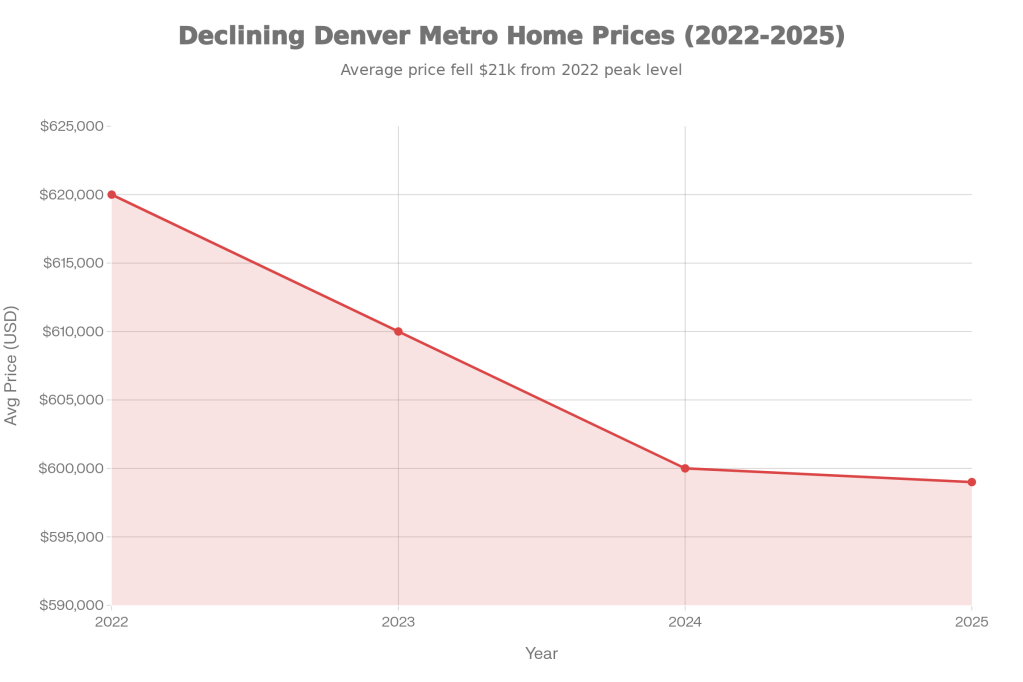
Longer DOM empowers buyers to select homes aligning with 7–10 year horizons, avoiding overpayment risks.
Seller Perspective on DOM for First-Time Buyer Markets
Sellers targeting first-timers price realistically: $550k–$700k medians sell in 30–45 days if staged for young families (open kitchens, fenced yards). Overpricing adds 20–30 DOM, eroding equity via carrying costs.
Final Step-by-Step Breakdown: From Search to Keys
- Month 1: Prepare – Get pre-approved, define priorities, study Littleton DOM via REcolorado.
- Month 2: Research – Tour 20+ homes, target 25+ DOM listings, build lender relationships.
- Month 3: Offer – Submit on motivated sellers, negotiate concessions leveraging extended time.
- Month 4: Inspect/Due Diligence – Full inspections, tax/HOA reviews, insurance quotes.
- Closing: Secure – Walkthrough, fund, plan updates.
- Post-Close: Stabilize – Equity projects, monitor market for refi opportunities.
Moving Forward in Littleton’s Evolving Market
Littleton’s extended days on market create a deliberate pace ideal for first-time buyers building lasting equity amid Colorado’s unique costs and commutes. Fundamentals—schools, access, resilient stock—sustain demand, rewarding those who navigate strategically.
Reach out to the authoring agent today for personalized Littleton market data, DOM analysis for your target neighborhoods, and a customized buying roadmap tailored to current conditions.



Why Pricing Strategy Matters More in a Balanced Market
This guide is part of our Current Real Estate Market Insights → [Current Real Estate Market Insights ] Centennial and the broader Denver metro have entered a balanced market where supply and demand align more closely, making precise pricing strategy the decisive factor between quick sales and prolonged listings. This equilibrium—marked by inventory levels up 25–40%…


How Interest Rate Movement Is Affecting Denver-Area Buyers
This guide is part of our Current Real Estate Market Insights → [Current Real Estate Market Insights ] Interest rate movements have reshaped the Denver-area housing market by altering affordability thresholds, slowing seller turnover, and handing buyers more leverage in negotiations. Current rates in the 6.5–7% range—more than double the lows of 2020–2021—directly impact monthly payments,…

Are Buyers or Sellers in Control Right Now? A Local Breakdown
This guide is part of our Current Real Estate Market Insights → [Current Real Estate Market Insights ] Denver metro real estate has reached a nuanced balance where neither buyers nor sellers hold outright control, but leverage tilts toward those who adapt to longer days on market, rising inventory, and selective pricing. This equilibrium matters because…
 Mile High Home Group - Welcome to Denver
Leave a comment