
This guide is part of our Current Real Estate Market Insights → [Current Real Estate Market Insights ]
Parker’s real estate market reflects a disciplined balance: inventory has grown, prices have stabilized after years of rapid gains, and buyer-seller activity now hinges on precise pricing, condition, and strategic timing rather than broad momentum. For buyers, sellers, and relocating homeowners in this Douglas County suburb, the current conditions emphasize preparation and realism, creating opportunities for those who align decisions with local realities like commute access to the Denver Tech Center and long-term ownership costs.
Parker housing market overview
Parker operates as a stable, family-oriented suburb southeast of Denver, drawing buyers who prioritize top-rated schools, low crime, and proximity to both urban jobs and open space. Recent trends show median sale prices in the mid-$600,000s to low-$700,000s, with homes taking longer to sell—often 40-60 days—compared to the sub-30-day frenzy of 2021-2022. Inventory levels have risen notably, up 20-30% year-over-year in many reports, shifting leverage toward informed buyers while requiring sellers to differentiate through preparation.
This equilibrium matters because it rewards substance over speculation. Buyers gain negotiating room on well-researched properties, while sellers who overprice or under-prepare face extended market time and potential concessions. Parker’s appeal endures due to its position along C-470, supporting commutes under 30 minutes to major employment hubs, even amid Colorado’s variable weather that tests road reliability.
Buyer activity trends in Parker
Buyers in Parker today act with greater deliberation, focusing on total ownership costs amid stabilizing mortgage rates around 6-7%. Pending sales have held steady or ticked up slightly in recent months, but closed transactions reflect selectivity: only the best-positioned homes move quickly. This pattern stems from higher inventory allowing comparisons across neighborhoods like Stroh Ranch, Pradera, and newer pockets near Hess Road.
For relocating professionals or growing families, Parker’s buyer pool values functional layouts—think main-floor offices, 4+ bedrooms, and unfinished basements for future expansion—over flashy finishes. Commute realities amplify this: properties near Parker Road or Twenty Mile Road command premiums for light rail and E-470 access, reducing door-to-door time to downtown Denver or Centennial Airport.
Why buyers have more leverage now
Increased days on market give buyers time to inspect thoroughly and request credits for Colorado-specific issues like aging roofs stressed by sun and snow cycles. Roughly 25-30% of listings see price reductions, signaling seller flexibility on concessions such as rate buydowns or closing costs. Thoughtful buyers use this to target homes with strong long-term value: energy-efficient builds from the 2000s onward that minimize utility spikes during freeze-thaw periods.
Seller activity and market feedback
Sellers in Parker face a market that provides clear signals through showings, offers, and analytics. New listings are up modestly, but absorption rates have slowed, with many homes pending after 4-8 weeks rather than days. Successful sellers price to recent comps—adjusting for lot size, updates, and HOA fees in master-planned communities—avoiding the pitfalls of anchoring to pandemic peaks.
HOA and metro district taxes add 10-20% to monthly payments in areas like Legend or Pine Lane, facts sellers must disclose transparently to build trust. Weather impacts showings too: winter listings require proactive snow management to avoid buyer perceptions of neglect.
Seller strategies that drive results
Top performers invest in staging and minor repairs upfront, as buyers scrutinize mechanicals and exteriors under Parker’s intense sunlight. Offering flexible terms—like covering buyer agent commissions or minor inspection fixes—closes deals faster in this balanced environment. Data shows priced-right homes still sell near list, underscoring that activity follows alignment with buyer priorities.
Housing stock and neighborhood dynamics
Parker’s inventory spans 1980s ranch-style homes on larger lots in central areas to 2010s townhomes and two-stories in east Parker developments. Older stock offers character and space but demands budgeting for systems like HVAC strained by altitude and temperature swings. Newer communities provide warranties and modern insulation but higher ongoing fees that erode affordability edges.
Neighborhoods differentiate sharply:
- Central Parker (e.g., Onyx, Country Club): Established appeal with mature landscaping; buyers pay for walkability to Mainstreet shops.
- East Parker (e.g., Stroh Ranch, Harmony): Growing inventory of family homes; shorter commutes to DIA via E-470.
- Luxury enclaves (e.g., Pradera, Sapphire Pointe): Steady seller activity for high-end buyers; resale holds due to gated amenities.
These variations explain why per-square-foot values cluster around $250-300, with outliers driven by updates and location.
Ownership costs unique to Parker
Beyond mortgage payments, Parker’s total costs include Douglas County’s property taxes (around 0.6-0.7% effective rate) and metro districts funding roads and parks. Insurance reflects wildfire proximity in foothill fringes, pushing premiums 20-30% above urban averages. Buyers modeling 7-10 year holds must project maintenance: $5,000-10,000 annually for exteriors weathering Colorado’s dry climate.
Commutes shape budgets too—fuel or transit passes add $200-400 monthly for Tech Center workers. Sellers who highlight efficiency upgrades (e.g., newer windows, smart thermostats) appeal to cost-conscious buyers.
Visualizing Parker’s market balance
The chart below approximates median sale price trends in Parker and nearby Douglas County from 2023-2025, showing stabilization after growth
Parker operates as a stable, family-oriented suburb southeast of Denver, drawing buyers who prioritize top-rated schools, low crime, and proximity to both urban jobs and open space. Recent trends show median sale prices in the mid-$600,000s to low-$700,000s, with homes taking longer to sell—often 40-60 days—compared to the sub-30-day frenzy of 2021-2022. Inventory levels have risen notably, up 20-30% year-over-year in many reports, shifting leverage toward informed buyers while requiring sellers to differentiate through preparation.
This equilibrium matters because it rewards substance over speculation. Buyers gain negotiating room on well-researched properties, while sellers who overprice or under-prepare face extended market time and potential concessions. Parker’s appeal endures due to its position along C-470, supporting commutes under 30 minutes to major employment hubs, even amid Colorado’s variable weather that tests road reliability.
Buyer activity trends in Parker
Buyers in Parker today act with greater deliberation, focusing on total ownership costs amid stabilizing mortgage rates around 6-7%. Pending sales have held steady or ticked up slightly in recent months, but closed transactions reflect selectivity: only the best-positioned homes move quickly. This pattern stems from higher inventory allowing comparisons across neighborhoods like Stroh Ranch, Pradera, and newer pockets near Hess Road.
For relocating professionals or growing families, Parker’s buyer pool values functional layouts—think main-floor offices, 4+ bedrooms, and unfinished basements for future expansion—over flashy finishes. Commute realities amplify this: properties near Parker Road or Twenty Mile Road command premiums for light rail and E-470 access, reducing door-to-door time to downtown Denver or Centennial Airport.
Why buyers have more leverage now
Increased days on market give buyers time to inspect thoroughly and request credits for Colorado-specific issues like aging roofs stressed by sun and snow cycles. Roughly 25-30% of listings see price reductions, signaling seller flexibility on concessions such as rate buydowns or closing costs. Thoughtful buyers use this to target homes with strong long-term value: energy-efficient builds from the 2000s onward that minimize utility spikes during freeze-thaw periods.
Seller activity and market feedback
Sellers in Parker face a market that provides clear signals through showings, offers, and analytics. New listings are up modestly, but absorption rates have slowed, with many homes pending after 4-8 weeks rather than days. Successful sellers price to recent comps—adjusting for lot size, updates, and HOA fees in master-planned communities—avoiding the pitfalls of anchoring to pandemic peaks.
HOA and metro district taxes add 10-20% to monthly payments in areas like Legend or Pine Lane, facts sellers must disclose transparently to build trust. Weather impacts showings too: winter listings require proactive snow management to avoid buyer perceptions of neglect.
Seller strategies that drive results
Top performers invest in staging and minor repairs upfront, as buyers scrutinize mechanicals and exteriors under Parker’s intense sunlight. Offering flexible terms—like covering buyer agent commissions or minor inspection fixes—closes deals faster in this balanced environment. Data shows priced-right homes still sell near list, underscoring that activity follows alignment with buyer priorities.
Housing stock and neighborhood dynamics
Parker’s inventory spans 1980s ranch-style homes on larger lots in central areas to 2010s townhomes and two-stories in east Parker developments. Older stock offers character and space but demands budgeting for systems like HVAC strained by altitude and temperature swings. Newer communities provide warranties and modern insulation but higher ongoing fees that erode affordability edges.
Neighborhoods differentiate sharply:
- Central Parker (e.g., Onyx, Country Club): Established appeal with mature landscaping; buyers pay for walkability to Mainstreet shops.
- East Parker (e.g., Stroh Ranch, Harmony): Growing inventory of family homes; shorter commutes to DIA via E-470.
- Luxury enclaves (e.g., Pradera, Sapphire Pointe): Steady seller activity for high-end buyers; resale holds due to gated amenities.
These variations explain why per-square-foot values cluster around $250-300, with outliers driven by updates and location.
Ownership costs unique to Parker
Beyond mortgage payments, Parker’s total costs include Douglas County’s property taxes (around 0.6-0.7% effective rate) and metro districts funding roads and parks. Insurance reflects wildfire proximity in foothill fringes, pushing premiums 20-30% above urban averages. Buyers modeling 7-10 year holds must project maintenance: $5,000-10,000 annually for exteriors weathering Colorado’s dry climate.
Commutes shape budgets too—fuel or transit passes add $200-400 monthly for Tech Center workers. Sellers who highlight efficiency upgrades (e.g., newer windows, smart thermostats) appeal to cost-conscious buyers.
Visualizing Parker’s market balance
The chart below approximates median sale price trends in Parker and nearby Douglas County from 2023-2025, showing stabilization after growth.
Denver Metro Average Home Price Trend, 2022–2025 (Approximate)
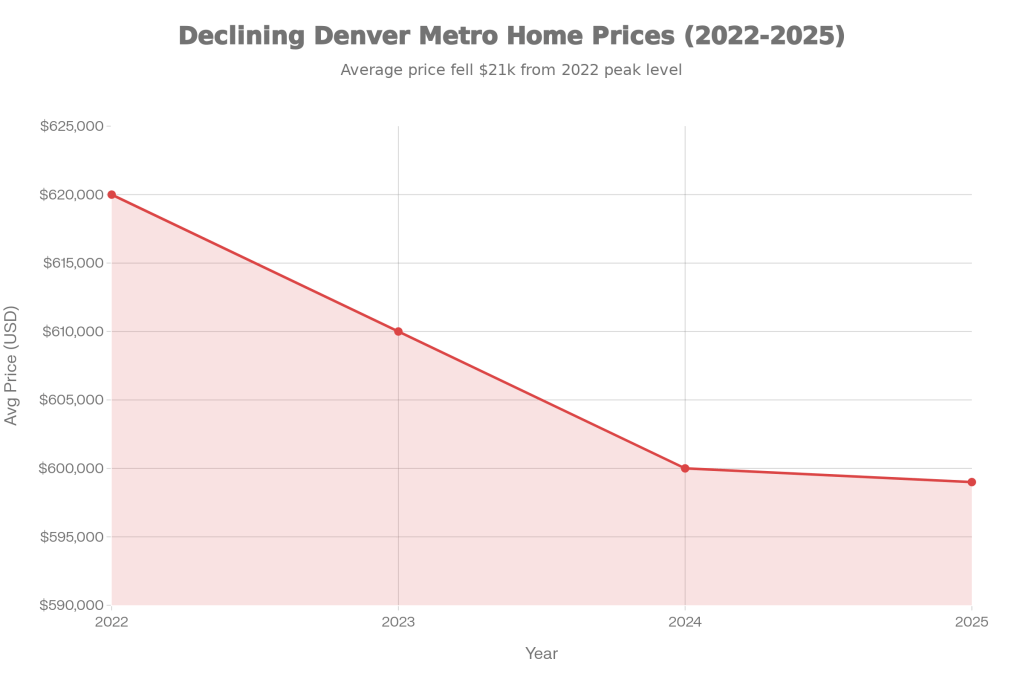
This trajectory—modest peaks followed by flattening—mirrors buyer caution and seller adjustments, with implications for timing moves.
Step-by-Step Guide for First-Time Buyers in Parker
For first-time buyers new to Parker’s market, treat the process as a structured evaluation of fit, finances, and future value. This guide assumes pre-approval and focuses on local nuances.
Step 1: Define priorities tied to Parker realities
List must-haves: school clusters (e.g., Pine Creek vs. Chaparral), commute under 25 minutes via C-470, and lot/privacy tolerance. Research Douglas County assessor data for tax estimates; factor HOA searches on community sites. Why? Misaligned priorities waste time in a market where inventory favors selectivity.
Step 2: Secure financing with local lenders
Get pre-approved by Colorado-based banks familiar with metro districts. Model payments including 1-2% reserves for snow removal and exterior maintenance. Stress-test at 7.5% rates—Parker’s prices demand it.
Step 3: Analyze recent comps neighborhood-by-neighborhood
Use REcolorado or agent portals for 90-day solds in target areas like Stroh or Legend. Adjust for Parker’s variables: +10% for updated kitchens, -5% for dated baths. Visit 10-15 homes to calibrate value.
Step 4: Tour strategically during peak conditions
Schedule east/west-facing homes midday to assess sun exposure. Note topography for drainage—Parker clay soils challenge basements. Prioritize winter showings for realism on plowing and heating efficiency.
Step 5: Make informed offers with protections
Bid 98-102% of realistic value based on comps, contingent on inspection and appraisal. Request seller disclosures on metro fees, past claims. In balanced markets, ask for credits on non-negotiables like fencing or appliances.
Step 6: Navigate inspection and underwriting
Hire inspectors versed in Colorado codes (e.g., radiant heat common in Parkers). Negotiate fixes or credits; expect pushback only on priced-right homes. Review title for easements affecting future expansions.
Step 7: Close with long-term planning
Budget post-closing reserves. Join neighborhood associations for resale insights. Refinance monitoring starts day one—Parker’s appreciation supports equity building.
Complete Process Breakdown: Beginning to End
- Preparation (Weeks 1-2): Clarify needs, get pre-approved, study Parker comps/taxes.
- Search (Weeks 3-6): Tour 20+ properties; narrow to 3-5 finalists.
- Offer (Week 7): Submit data-backed bid with contingencies.
- Due Diligence (Weeks 8-9): Inspect, appraise, negotiate repairs/credits.
- Under Contract (Weeks 10-11): Finalize loan, title review.
- Closing (Week 12): Walk through, sign, fund—move in. Total: 3 months in current market.
Parker’s market path ahead
Parker’s buyer and seller activity points to sustained equilibrium, bolstered by job stability and constrained land supply. Disciplined participants thrive by focusing on property fundamentals amid Colorado’s commute and weather demands.
If you’re buying, selling, or relocating in Parker, reach out to the authoring agent today for personalized comps, strategy, and market data to guide your next steps effectively.



Why Pricing Strategy Matters More in a Balanced Market
This guide is part of our Current Real Estate Market Insights → [Current Real Estate Market Insights ] Centennial and the broader Denver metro have entered a balanced market where supply and demand align more closely, making precise pricing strategy the decisive factor between quick sales and prolonged listings. This equilibrium—marked by inventory levels up 25–40%…


How Interest Rate Movement Is Affecting Denver-Area Buyers
This guide is part of our Current Real Estate Market Insights → [Current Real Estate Market Insights ] Interest rate movements have reshaped the Denver-area housing market by altering affordability thresholds, slowing seller turnover, and handing buyers more leverage in negotiations. Current rates in the 6.5–7% range—more than double the lows of 2020–2021—directly impact monthly payments,…

Are Buyers or Sellers in Control Right Now? A Local Breakdown
This guide is part of our Current Real Estate Market Insights → [Current Real Estate Market Insights ] Denver metro real estate has reached a nuanced balance where neither buyers nor sellers hold outright control, but leverage tilts toward those who adapt to longer days on market, rising inventory, and selective pricing. This equilibrium matters because…
 Mile High Home Group - Welcome to Denver
Leave a comment