

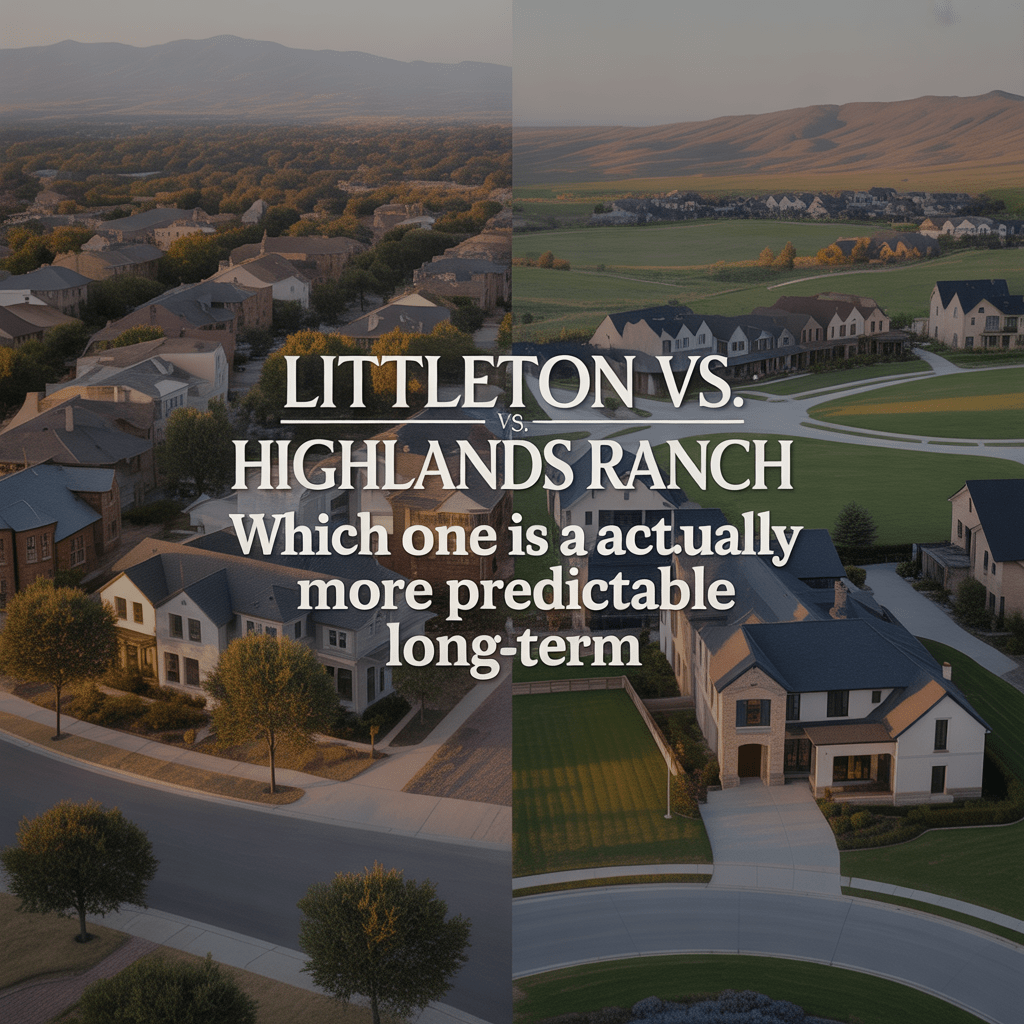
To get more information on Highlands Ranch→ [Highlands Ranch] & To get more information on Littleton→ [Littleton]
Colorado’s south metro suburbs draw serious buyers seeking stability amid Denver’s growth pressures. Littleton and Highlands Ranch stand out for their established housing stock and proximity to employment hubs, but predictability in real estate hinges on factors like value retention, ownership costs, and external influences that affect long-term holding. This analysis compares the two based on market history, local economics, and structural differences to help buyers and sellers gauge which offers more reliable outcomes over decades.
Location and Commute Realities
Both communities benefit from C-470 access, but their positions shape daily and long-term utility.
Littleton sits closer to central Denver, roughly 10 to 15 miles away, enabling shorter drives for those working downtown or along the southwest corridor. This proximity supports light rail options via RTD stations, reducing reliance on personal vehicles and mitigating traffic volatility from I-25 expansions or remote work shifts.
Highlands Ranch, positioned farther south at 20 to 25 miles from downtown, excels for DTC and south office park commuters, often reaching those sites in 5 to 15 minutes. Buyers prioritizing Tech Center jobs find this edge enduring, as regional job growth sustains demand without overdependence on unpredictable downtown traffic.
Why it matters: Commute predictability influences resale appeal. Littleton’s transit ties buffer against car-dependent risks like fuel costs or road projects, while Highlands Ranch’s highway focus aligns with stable suburban employment patterns.
Housing Stock and Development Patterns
Established inventory defines long-term supply dynamics in both areas.
Littleton features a mix of pre-war bungalows, mid-century ranches, and limited newer builds, preserving scarcity in walkable neighborhoods near trails and schools. This older stock demands periodic updates but holds value through character and location, with low turnover reinforcing steady demand.
Highlands Ranch, a master-planned community from the 1980s onward, offers uniform newer homes with consistent lot sizes and amenities funded by metro districts. While this provides move-in readiness, overlapping districts introduce variability in future assessments for infrastructure like roads and pools.
Predictability edge: Littleton’s organic growth limits supply shocks from overbuilding, fostering gradual appreciation—around 7% annually over the past decade in some metrics—versus Highlands Ranch’s potential for phased sell-offs affecting localized pricing.
Historical Appreciation and Market Resilience
Past performance reveals how each handles economic cycles.
Littleton’s values have shown consistent upward trends, with 97% cumulative appreciation over ten years through recent data, outpacing national averages despite short-term slowdowns to 1.6% yearly. Resilience stems from diverse buyer pools: commuters, downsizers, and locals valuing downtown access over flashier features.
Highlands Ranch medians hovered near $695,000 mid-2025, with a 4% dip from prior peaks but projections to $770,000 by 2029 amid balanced inventory growth. Planned uniformity supports rental demand, yet softening sale-to-list ratios signal sensitivity to rates.
Why trends matter: Littleton’s steadier path—moderate gains without boom-bust swings—suits long-term holders avoiding volatility from Highlands Ranch’s newer, higher-base pricing.
Ownership Costs Breakdown
Annual expenses reveal hidden predictability risks.
Property taxes favor Douglas County’s Highlands Ranch at ~0.42% effective rate versus Arapahoe’s ~0.50% in Littleton, translating to hundreds less yearly on comparable homes. Colorado’s low baseline—around 0.5% statewide—amplifies this, but Highlands Ranch adds metro district mill levies for amenities, potentially equating or exceeding totals based on debt schedules.
Utilities and maintenance align with weather patterns: both face dry summers straining irrigation and cold winters testing heating systems, but Littleton’s varied older homes may incur higher upkeep absent planned reserves.
Insurance reflects regional fire and flood risks, with metro district-funded mitigations in Highlands Ranch providing a buffer, though buyers must review specific levies. Overall, Highlands Ranch edges on taxes if districts stabilize, but Littleton’s simplicity avoids surprise assessments.
Why costs matter: Predictable outflows preserve equity buildup. District dependencies in Highlands Ranch could fluctuate with bond maturities, while Littleton’s municipal model ties to broader county stability.
Schools and Family-Driven Demand
Education anchors generational holding power.
Littleton Public Schools earn top marks, ranked among Colorado’s best with strong college prep and community involvement. This draws families planning 10-20 year stays, stabilizing neighborhoods through consistent enrollment.
Highlands Ranch falls under Douglas County schools, also elite, with STEM-focused options like STEM School Highlands Ranch boosting appeal. Metro district support enhances facilities, but boundary shifts from growth could subtly impact perceptions.
Predictability tie: Both sustain premium pricing via schools, but Littleton’s district cohesion reduces rezoning risks tied to rapid expansion elsewhere in Douglas County.
External Factors: Weather and Economy
Colorado specifics test resilience.
Winter snow and summer drought affect both, elevating heating costs and yard maintenance, yet robust infrastructure—Littleton’s city services, Highlands Ranch’s districts—handles routine demands. Economic ties to Denver’s tech and energy sectors support in-migration, with Highlands Ranch nearer DTC buffering recessions via office proximity.
Littleton’s light rail and historic core attract remote workers, diversifying beyond commutes. Voter-approved tabs like those limiting Douglas County tax hikes add fiscal discipline.
Why it matters: These insulate against downturns. Highlands Ranch’s planned buffers aid recovery, but Littleton’s diversity tempers overreliance on single corridors.
Long-Term Predictability Verdict
Littleton emerges slightly more predictable for conservative buyers and sellers. Its organic evolution, transit access, and lack of district variables yield steadier appreciation and simpler costs, ideal for 15-30 year horizons where resale hinges on broad appeal. Highlands Ranch suits those valuing uniformity and tax edges, provided district finances align, offering strong returns in growth phases.
Neither guarantees immunity to rates or migration shifts, but both outperform volatile urban cores. Serious decision-makers weigh personal commutes and budgets against these structures.
Reach out to me directly for a tailored analysis of your situation, including current comps and tax projections in Littleton or Highlands Ranch. Contact details below—let’s discuss how these dynamics fit your long-term plans.



Parker vs Castle Rock: Where Over-Improving Hurts More
To get more information on Parker→ [Parker] & To get more information on Castle Rock→ [Castle Rock] Parker and Castle Rock sit just a few exits apart on I‑25, but they behave differently when it comes to how far you can push upgrades before the market stops paying you back. In both towns, over‑improving is a real…


Parker vs Castle Rock: What “Newer Homes” Really Mean
To get more information on Parker→ [Parker] & To get more information on Castle Rock→ [Castle Rock] Buyers in Douglas County’s southern suburbs often weigh Parker against Castle Rock for their blend of space, schools, and Denver access. Both towns deliver established family neighborhoods with median home prices around $700,000, yet resale outcomes diverge due to subtle…

Parker vs Castle Rock: The Hidden Resale Risk
To get more information on Parker→ [Parker] & To get more information on Castle Rock→ [Castle Rock] Buyers in Douglas County’s southern suburbs often weigh Parker against Castle Rock for their blend of space, schools, and Denver access. Both towns deliver established family neighborhoods with median home prices around $700,000, yet resale outcomes diverge due to subtle…
 Mile High Home Group - Welcome to Denver
Leave a comment