


To get more information on the Denver Market→ [Current Market Insights] & About the Buying Process in Denver Metro→ [Denver Metro Home Buying Process]
In Denver’s competitive housing market, the phrase “write a strong offer” has become almost a reflexive piece of advice. Buyers hear it from agents, friends, and lenders alike. But what exactly defines a strong offer in a market as nuanced as Denver’s—and why does it matter beyond simply offering more money?
The reality is that writing an effective offer in this metro area is less about emotion or aggressiveness and more about aligning with how sellers think, how listings are evaluated, and how risk is managed. A truly strong offer isn’t just high—it’s clean, credible, and strategically constructed around local realities that shape behavior, perception, and timing.
Understanding Market Context: Denver’s Distinct Housing Psychology
Denver’s real estate market operates on its own rhythm. Inventory moves with the seasons, interest rates reshape buyer pools, and local economic undercurrents—from tech employment to in-migration— quietly influence both confidence and urgency.
In many metro areas across the country, “strong” means “highest and best.” In Denver, however, sellers weigh nuanced factors in addition to price. They consider how confident they feel that a deal will actually close, how repair demands could interrupt their own moving timeline, and whether the buyer’s financing feels solid in a region with relatively high median home values. A $950,000 deal in Central Park or Highlands Ranch demands a different lens of scrutiny than a $450,000 townhouse in Lakewood—yet both rely on credibility as much as cash.
Sellers here have long memories. After the fast-paced run-up in 2020–2022 and the interest rate adjustments that followed, they’ve learned to favor certainty over exuberance. This psychology shapes everything about how offers are perceived.
Price Still Matters—But Structure Speaks Louder
In every cycle, buyers wonder whether they should “stretch” to win. The real question is whether their offer feels well structured from the seller’s perspective. In Denver, that means several things:
- Proof of funds and lender credibility: In a metro area where average prices hover near or above $600,000, listing agents scrutinize pre-approval letters carefully. Local lenders familiar with Colorado appraisal timelines carry more weight than out-of-state institutions promising pre-qualification.
- Appraisal gaps: When multiple offers are competing, a buyer comfortable covering a gap—even a modest one—automatically signals lower risk to the seller. That assurance can offset a slightly lower offer price.
- Escalation clauses: Denver sellers often view escalation clauses with skepticism if they’re too open-ended or confusing. A clean, well-documented offer still tends to outperform one that looks overly engineered.
Ultimately, structure communicates confidence. Sellers can sense when an offer is written with intention versus one that’s simply been inflated under pressure.
Flexibility: The Quiet Currency of a Strong Offer
In Denver, timing often rivals price in importance. Job relocations, new construction timelines, and school-year moves create distinct pressures for both buyers and sellers. A strong offer anticipates those variables.
- Post-closing occupancy is a powerful negotiating lever. Allowing the seller additional time to move out, free or at a modest rental rate, reduces their logistical stress and communicates empathy with their situation—a key differentiator in a multiple-offer environment.
- Flexible closing dates—particularly those coordinated with the title company’s holiday schedule or lender processing backlog—signal that the buyer understands local transaction flow.
- Limited contingencies—such as inspections restricted to health and safety items—can prevent small defects from derailing trust mid-transaction.
In short, the Denver market rewards offers that make the seller’s life easier without creating unbalanced risk.
Inspection Realities in Colorado’s Housing Stock
Colorado’s housing stock presents specific inspection challenges. Much of Denver’s urban core and first-ring suburbs—such as Arvada, Wheat Ridge, and Englewood—feature mid-century construction. Outlying communities like Parker, Erie, and Castle Pines skew newer but still face soil movement and drainage concerns.
Sellers know that certain inspection findings are almost guaranteed: aging sewer lines, deferred maintenance, roof wear from seasonal extremes, or older mechanical systems nearing the end of their life cycle. A strong offer anticipates these realities.
Savvy buyers approach inspections with context rather than alarm. When an inspection request is narrowly tailored—asking for, say, replacement of a key safety component rather than a laundry list of cosmetic issues—it shows professionalism. In a city where many homes pass through several rounds of ownership, respect for a property’s age and condition fosters goodwill and often keeps a deal intact when emotions rise.
Financing in a Higher-Rate Environment
Rising mortgage rates changed the mechanics of “strong offers” in profound ways. In 2021, buyers competed primarily on price acceleration. In the current environment, strength means demonstrating financial depth and readiness.
Sellers now look for signals of stability: shorter loan approval timelines, verified down payment reserves, and communication from reputable local lenders. When interest rates fluctuate, even modestly, a less-prepared buyer can suddenly fall out of qualification. Sellers and their agents know this risk well, which is why detailed lender communication has become just as persuasive as price escalation.
Buyers who understand that transparency builds leverage tend to craft more effective offers. A pre-underwritten mortgage file—meaning all documents have been verified by the lender before the offer is written—significantly increases a seller’s confidence that the deal will close as written.
Emotional Intelligence: Reading the Seller
Too often, buyers assume negotiation is adversarial. In Denver’s interconnected market, empathy and professionalism are strategic assets. Listing agents often communicate a seller’s priorities indirectly: a need for leaseback flexibility, a request for a simple transaction, or a preference to close before a job transfer date.
A buyer who listens, responds thoughtfully, and reflects those conditions in their offer stands out. Sellers here are often relocating within the metro—downsizing from Highlands Ranch to Littleton, or trading urban living in Wash Park for a foothills property in Evergreen. Offers that reduce their transition friction tend to beat purely financial ones.
The subtext: a strong offer feels human. It acknowledges the realities of moving, financing, and timing that both sides face.
Why Clean Paperwork Still Wins Deals
In a competitive environment, technical precision often separates success from near-miss. Well-organized, error-free contracts convey reliability. Deadlines aligned correctly with title deadlines, properly executed earnest money delivery, and a clear cover letter outlining offer highlights all reinforce credibility.
Denver-area agents often share feedback that “clean contracts” are easy to present to sellers, who may be reviewing multiple offers in a single evening. Offers cluttered with unnecessary disclaimers, handwritten modifications, or incomplete addenda waste cognitive bandwidth at a critical moment.
A strong offer therefore mirrors professionalism: concise, complete, and respectful of the process.
The Invisible Factor: Market Timing and Seller Fatigue
One rarely discussed aspect of crafting a strong offer in Denver is timing—not just when a property hits the MLS, but how long it has been sitting. In peak-condition price brackets, listings that linger beyond two weeks often experience subtle seller fatigue.
Understanding that psychology can inform strategy. Early in a listing’s lifecycle, enthusiasm drives expectations. Offers at or above list may be required. Later, once traffic slows, sellers often recalibrate their mindset. Thoughtful buyers recognize this pivot and craft offers that balance fairness with empathy, avoiding opportunism but still acknowledging changing leverage.
Conversely, rushing to “win” a property on day one can lead to unnecessary escalation if the listing was mispriced from the start—a common occurrence in transitional markets. True strength, therefore, also includes the discipline to wait for pricing alignment.
Why “Winning” Isn’t Always the Goal
In Denver, short supply and resilient demand can tempt buyers to chase every listing as if it’s irreplaceable. However, veteran buyers understand that market conditions shift and inventory evolves seasonally. Winning the wrong house—overpaying for an inferior lot, backing to a busy street, or compromising future resale appeal—can create long-term frustration.
The strongest offers are informed, not impulsive. They reflect a balance between the emotional pull of ownership and the disciplined evaluation of long-term value. That distinction matters more in Denver than in many markets because housing appreciation here tends to track more with neighborhood stability, commute access, and school quality than with speculative swings.
Long-Term Implications for Buyers and Sellers
For buyers, understanding what constitutes a strong offer builds confidence and reduces stress in future negotiations. For sellers, it clarifies what to prioritize when evaluating competing bids. Both sides benefit from an environment rooted in transparency and mutual respect.
Denver’s real estate transactions operate best when expectations are realistic, timelines are transparent, and each side respects the economic and human dimensions of the process. The strongest offers— and the smoothest closings—grow from careful preparation and quiet professionalism rather than dramatic gestures.
Final Thoughts: Strength Through Strategy, Not Emotion
The idea of a “strong offer” in Denver has evolved. It’s no longer purely about offering the highest number or waiving every contingency. True strength lies in credibility—financial, logistical, and relational.
A well-prepared buyer, working with a proactive local agent and a trusted lender, can position themselves decisively without overextending. Sellers notice that balance. In an era of shifting interest rates, changing buyer dynamics, and selective inventory, strength means precision and foresight rather than sheer boldness.
If you are preparing to buy or sell in the Denver metro area and want to navigate this landscape with strategy and confidence, reach out to me for expert guidance grounded in data, local insight, and negotiation experience. A strong offer—and a successful closing—always begin with informed preparation.



Littleton vs. Highlands Ranch: What “Resale Safety” Really Means in Each Area
To get more information on Highlands Ranch→ [Highlands Ranch] & To get more information on Littleton→ [Littleton] Littleton vs. Highlands Ranch: What “Resale Safety” Really Means in Each Area Colorado’s south metro suburbs draw serious buyers seeking stability in volatile markets. Littleton and Highlands Ranch stand out for their established housing stock and proximity to Denver, but…

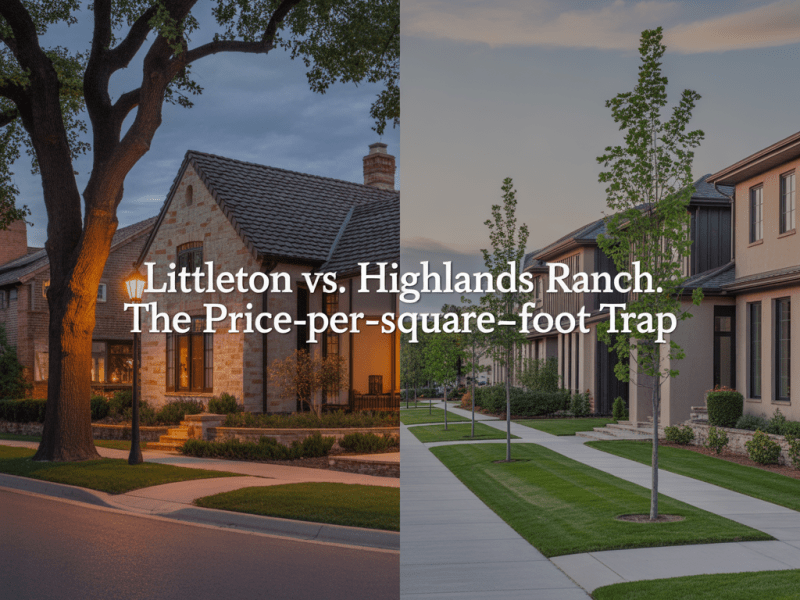
Littleton vs. Highlands Ranch: The Price-Per-Square-Foot Trap
To get more information on Highlands Ranch→ [Highlands Ranch] & To get more information on Littleton→ [Littleton] Buyers in the Denver metro area often compare Littleton and Highlands Ranch by focusing on price per square foot, assuming it reveals the best value. This metric can mislead because it overlooks differences in home quality, neighborhood governance, long-term costs,…

Littleton vs. Highlands Ranch: Appreciation vs. Lifestyle Value
To get more information on Highlands Ranch→ [Highlands Ranch] & To get more information on Littleton→ [Littleton] In the south Denver metro area, Littleton and Highlands Ranch stand out as prime choices for buyers and sellers weighing long-term financial returns against daily living quality. Littleton offers historic charm and superior urban access, while Highlands Ranch delivers master-planned…
 Mile High Home Group - Welcome to Denver
Leave a comment